The One That Got Away: Tips to Engage Email Non-Responders

Higher Ed Marketing & Student Search Services | enrollmentFUEL | image of person holding a tablet with envelope icons

The One That Got Away: Tips to Engage Email Non-Responders

Do you ever wonder about the one that got away? When working to recruit a new class, mulling over what to do about the prospective students who have stopped engaging with emails may bring to mind lyrics from The Clash, or maybe lines from Shakespeare.

All things considered, the lyric “Should I stay, or should I go” and the line “To be, or not to be” resemble the real question you’re trying to answer, which is: “Should I email, yes or no?” 

And, as with most things in life, the answer to that question is much more complex than a simple yes or no.

Before answering, there are two things you should analyze. 

  • How many total emails have you sent?
  • How frequently are you emailing?
  • Has there been a change in overall performance?
    • Open, click, and click-to-open rates
    • Marked as spam rates
    • Unsubscribe rates
    • Bounce rates
  • Have they engaged at all?
  • How long have you been communicating with them?
  • When was the last time they engaged?

The more emails you send to prospective students who do not engage, the higher the likelihood your overall domain reputation will suffer. To compound matters, if your spam, unsubscribe, and bounce rates rise at the same time, it can hurt domain reputation even more. At that point, many senders find themselves blacklisted or getting a Bad reputation in Google Postmaster. If that happens, all of your emails start going straight to the Spam folder.

Here are a few things you should do to ensure your domain reputation stays High:

Validate all email addresses before sending the first email and repeat this process annually. You’ll probably find that prospective students have multiple email addresses. Each email address has a specific purpose, and sometimes students stop using or monitoring them. With Apple Mail Privacy Protection, prospective students even have the opportunity to hide their true email address. There are multiple services available that validate email addresses. Consider trying multiple services to find the one you prefer. 

Prior to adding an email to your comm flow, run it through a Spam tester to determine inbox placement.

Proper Preparation Prevents Poor Performance

Has your email program ever warned you that they “could not verify the identity of the sender” or “The actual sender of this message is different from the normal sender”? Did it keep you from opening the email? Given the volume of identity theft and email spoofing, most people hit the Delete key. To keep this from happening to your emails, make sure DNS records for SPF, DKIM, and DMARC are in place for all of the marketing platforms you use.

Be Vigilant

Constantly monitor your domain reputation on Google Postmaster, and monitor your domain for blacklisting while your comm flow is running.

If you have everything in place to maintain a High domain reputation and you really want to send emails to the prospective students who aren’t engaging, create a specific landing page and a short three- to five-email series to try one last time to get them to engage. Instead of automatically including all non-responders, consider choosing those with at least some engagement within the last three to six months for maximum effectiveness.

The good news is, you still have options available and tools to prevent a non-responder from becoming “the one that got away!” You may have the resources in-house to effectively recapture the attention of these elusive prospects using some or all of the channels listed below: 

  • Have a counselor call or send a text
  • Send direct mail
  • Use Google advertising
    • Allows you to upload a customer list under 18 and find matches
    • Run PPC ads with generic terms to this audience. If a prospective student on your list enters one of the generic search terms, your ad will appear at the top.
    • Run discovery image/text ads that appear on YouTube, in Gmail, and in the Discover app.
  • Run digital advertising and social media advertising to non-responder households
    • Display, native, and pre-roll campaigns
    • Connected TV with retargeting display campaigns
    • Facebook/Instagram, Snapchat, TikTok

What’s more, enrollmentFUEL is always ready, willing, and able to serve as your partner, support, and wingman in your efforts to recapture “the one that got away” as you recruit your new class!


5 Data Concepts You MUST Consider for Higher Education Enrollment

image of various icons in relation to lists, data, and verification | Higher Ed Marketing & Student Search Services | enrollmentFUEL

5 Data Concepts You MUST Consider for Higher Education Enrollment

The ever-changing higher education recruitment landscape is filled with data challenges and opportunities that can make or break even the soundest enrollment management strategies. From disparate digital footprints and affinity milestones to in-person touchpoints, data are everywhere (and nowhere) at the same time!

Here are five data concepts you MUST consider in your strategic planning that will help provide clarity and consistency as you recruit your next class. 

Data frameworks are the foundation of any successful enrollment management analytics initiative. Without a framework, your data will be inconsistent, untrustworthy, and unmeasurable. At minimum, a data framework should include the questions being asked/answered, what data are used to answer the questions, ownership and governance, and a way to measure effectiveness. Start with these four things, and you’ll be set up for success! 

All data has the potential to be “dirty,” regardless of source. Consider how much control or structure is available for vendor data vs. internal CRM/SIS systems. The biggest ROI difference is how consistently data are ingested, cleansed, and staged for insight and decision-making purposes. Does your Student Search vendor cleanse and standardize data on your behalf (enrollmentFUEL does!), or simply provide raw extracts? Data quality reigns supreme over data quantity.

Is it possible to accurately forecast yield with data refreshed at different intervals? The answer is yes, to an extent; but mapping out, as part of a framework, the source, timing, and availability of key data points will pay dividends in your enrollment analytics strategy. Think of the different touchpoints like digital marketing, virtual events, campus tours, customer service inquiries, financial aid application filing, etc. While most of these happen in real time, it’s rare to have a data framework that supports real time reporting across every touchpoint. Relate the questions to the timing of data availability, and decide if it’s possible or makes sense to use a particular metric as part of the admissions decision-making stage.

With the proliferation of data across disparate sources, it’s crucial that your framework accounts for outliers, particularly where scoring is used in modeling/forecasting efforts. Create processes to look for the inverse of what you want to identify, simply to account for the unexpected dirty data, file layout changes, and processing delays. If there is a key metric driven on a particular string data value, and one day there are unexpected or null values, does your framework account for those, and are they treated in a way such that the entire scoring process breaks, or does it allow for proactive research/troubleshooting along the way?

Once the framework is in place, it’s time to tell the story with data. This will vary by desired analytical outcome, so try to tie it back to the initial questions being asked, and if they are answered. Strive to include the right mix of descriptive (what happened in the past), diagnostic (why it happened), and predictive (what may happen in the future) analysis to tell an actionable data story. Are application and FAFSA numbers up/down at the same rate? Are there system limitations preventing solid historical benchmarks? Is something happening in the marketplace that is causing unusual melt rates?

With these five data concepts in place, funnel management questions become easier to answer and act on.The enrollment landscape is increasingly complex—a good understanding of your data will help you ask the right questions, tell the right stories, and increase the likelihood that your enrollment strategies succeed. 

Authenticity Still Matters in Your Enrollment Management Strategy

Higher Ed Marketing & Student Search Services | enrollmentFUEL | image of person touching an icon of a checkmark

Authenticity Still Matters in Your Enrollment Management Strategy

In our age of carefully curated social media feeds featuring beautifully filtered photos, it can be easy to assume that authenticity somehow matters less to the current generation of prospective students. But when it comes to the business of recruiting a new class, nothing could be further from the truth.

To find high school graduating seniors who are the right fit for your school can sometimes feel like it requires a magician’s wand. After all, strategic enrollment management is about more than meeting admissions goals every recruiting cycle. Student retention is just as important as yield when it comes to the overall, long-term health of your school. Filling seats with students who are not likely to retain only means you’re tasked with making up the loss next year, which can easily become a never-ending cycle. (And one that is particularly challenging in the face of the demographic cliff.)

So, you may be asking yourself, does authenticity play a role in recruitment and retention and if so, should I be worried? To support our client-partners and enable us to better assist your recruitment efforts, we conduct a lot of research and strive to stay in touch with the needs and concerns voiced by prospective students. During a prospective student focus group, our team was struck by one participant, who stated that they felt like the communications and mailings they’d been receiving told one story, but the campus visit, specifically the campus tour, told them another. 

The incongruence of what had been “sold” to them versus what they saw for themselves first-hand felt disingenuous at best and, at worst, like they’d been flat out intentionally deceived. As unfortunate as that was to hear, it was more disconcerting to hear that this feeling was shared by prospective students visiting a variety of institutions. Unsurprisingly, students were far less likely to continue the admissions process whenever they spotted inauthenticity. 

How can you ensure you’re staying true to your institution’s identity?

Authenticity matters. And recent research agrees. A research study identified the importance of authenticity, finding institutions that tied their recruitment efforts to their mission saw higher yield between admitted and enrolled students than those that did not1.  

So, first things first, consider your enrollment marketing and communications through the lens of your school’s mission, vision, and core values. They should be the cornerstone on which your institution’s culture has been built. This requires stepping outside of yourself and putting yourself in the position of your prospective students or their families, asking some tough questions, and attempting to answer them earnestly. 

An example might be, if I didn’t know anything about the institution I am marketing, would I be able to get a sense of who we are—our mission, vision, core values, and culture—by:

  • Visiting our website; 
  • Looking at our social media;
  • Reading one of our direct mail pieces;
  • Opening one of our emails; or
  • Visiting our campus?

If you’re honest, most likely some or all of the above may need to be refreshed from the new perspective afforded when viewing your institution through this lens. Beautiful campus photos are lovely, but they do not represent the sum of the unique experience your school offers. Don’t hide your school’s light under a bush! Find ways to convey your distinct vision, mission, core values, and culture. Because when you do, prospective students will see your light shining brightly, and begin to see how their own light may shine if they enroll.

Ensuring that your web, social, and print materials convey your school’s vibe is key. But as enrollmentFUEL President, Dr. Jacquelyn D. Elliott, so succinctly shared in her article featured in Vol. 4, Issue 2 2020 of Octane, “People come to your campus to learn what your web and print material cannot convey.” Below is an excerpt from Dr. Elliott’s full Octane article, “How Storytelling Can Reshape the Campus Visit Experience.” You can also read the full article in our Octane Library:

…Don’t miss the opportunity! The campus visit should help students and families visualize the experience of being a student on your campus. Stories make that happen in an engaging way. Stories create connections and loyalty, stir emotions, and make complicated things much easier to understand. Perhaps one of the most critical aspects of the storytelling process is that of credibility. I say this because most people want to know, ‘What’s in it for me?’ Today’s consumer focuses on three people: Me, myself, and I. So, the only thing your student cares about is, ‘Will this be the right place for me?’…”

Don’t be afraid to “step out of the boat”! Taking a risk every now and then really makes the world a better place. Consider adopting some practices that encourage you and your team to step out of the boat. FUEL’s Boat Day is a personal example I like to share. To commemorate the founding of enrollmentFUEL—the day I “stepped out of the boat,” every February 10th, we close for the day so that each member of our team has the opportunity to do something new, challenging, or daring. This is an annual reminder to us, as a company, to lean into life, grow from new experiences, and think differently. 

It can be easy to stick with the familiar and sometimes even fear the unknown, but allowing fear of the unknown to turn into complacency can stagnate your recruitment efforts. Making it a habit to step out of the boat where your enrollment marketing is concerned wards off such stagnation. 

Explore and find new ways to authentically share your institution with prospective students. Is there some new digital marketing or social media marketing strategy that you’re curious about but have hesitated to try? There’s no time like the present.

Identify prospective students most likely to enroll and succeed at your school and pursue them intently. When recruiting a new class, who wouldn’t want a crystal ball? Conducting focus groups and survey research is one way to help you identify some characteristics of students who have historically been successful at your school. If you’re looking to explore beyond traditional methods, technology continues to evolve and place more tools within your reach to help you predict the future and work more efficiently. 

A plethora of digital marketing solutions are out there to equip you with the tools you need to improve your funnel management and successfully meet your goals. Our predictive modeling solution is a great example of how we can help your team focus on the “right” students through a review of historical enrollment patterns, high school characteristics, and demographics. Using our look-alike predictive model, we can identify households with future college-aged students who are the most similar to your prior enrolling students. Once you’ve identified prospective students more likely to succeed at your school, don’t forget to develop an omnichannel approach to strategically target them.

Research suggests that a school’s brand is most powerful when organizational identity and external image align with its values and mission. This means that understanding the mission and culture of your school is vital when crafting your messaging and promotions for prospective students.  

The moral of the story is this: don’t let the carefully curated social media feeds filled with highly filtered images fool you. Today’s prospective students care just as much as their predecessors, and their authenticity radar may be faster at spotting inauthenticity because their access to technology means they’ve basically been their own PR machines for years now.

1 Orosy, G., & Kilgore, W. (2020). Higher education lags in use of brand management techniques to recruit high school seniors. Strategic Enrollment Management Quarterly, 7(4), 3-16.

The Time to Build the Habit of Marketing Testing is Now

image of various icons in relation to overall strategy | Higher Ed Marketing & Student Search Services | enrollmentFUEL

The Time to Build the Habit of Marketing Testing is Now

While the idea of being able to master any skill after 10,000 hours of practice has been debunked, the concept of continually trying new approaches to improve holds true. It’s important to enrollment marketing, as standing still means falling behind. Your marketing and enrollment data analytics represent an opportunity to optimize your school’s advertising investment and strategies. What’s more, ever-evolving technology has placed seemingly endless amounts of data at your fingertips. However, as busy higher education marketers, it can be easy to feel overwhelmed by the copious amounts of performance data available and to practice the rule of “set it and forget it” to move on to the next item on your ever-growing to-do list. So, what are some easy ways to continually improve your enrollment marketing strategies without taxing your ability to get it all done?

Who hasn’t dreamed of living dangerously like James Dean in Rebel Without a Cause from time to time? Have you heard it’s best to send emails on Tuesdays? Try Fridays instead. Always use your brand to post on social media? Try posting from the Dean or a student instead.

If you’re testing an email subject line, don’t also change the call-to-action. Otherwise, you won’t know which change made the difference. Also, be sure not to test too many variations at once of the element you’re testing. If you’re testing an email subject line, only test 2-3 subject line variations at a time. A/B testing helps you make unbiased data-driven decisions when identifying the best marketing strategies.

Act like a scientist by running experiments several times. This will ensure your initial results hold true over time and different scenarios, while also giving you and your team time to set up the next test. That way, it won’t feel overwhelming, and you’re able to gain new information each time. What a way to really put the strategy into strategic enrollment management!

Sometimes, people who are not in the forest with us are able to pull back and see the bigger picture, or better yet, a completely fresh, untested one. Asking not only for feedback but also for contributing support gives your team bandwidth to move on to the next element of your campaign.

Now that you’ve identified key performance metrics and are monitoring them, don’t be shy about using the information to gain knowledge about your market, make course corrections when needed, and inform future strategy. 

Once you’ve integrated testing into your marketing strategy, don’t stop! Incremental changes can soon add up in big ways! Testing can help you further segment and target your market. Who knows, it may even help you identify your best channels for lead generation if you isolate and test one by one!

Truly, continually testing shouldn’t feel daunting. If you’re on autopilot with your campaigns, the likelihood is that over time, they will stop performing and grow stale, especially in the fast-moving digital marketing space. This means you can’t afford not to test. 

If you don’t have time to pause and review the performance of your enrollment marketing efforts, you should scale back and do a few things well. Or, you can call us at FUEL to help partner with you to consult or execute on your enrollment marketing campaigns.

Happy testing!

A Small Student Search Solution with Big Wins

Higher Ed Marketing & Student Search Services | enrollmentFUEL

A Small Student Search Solution with Big Wins

In 2009, I met with the Admissions team at Duke University. Our conversation covered many topics, including a new technology. I showed them something I was working on at the time.

It was a card that tied into an early-day version of augmented reality. If a student scanned the card with a downloadable app, they would open the door to new information. What was even better was that the enrollment director would get an alert telling them that the card had been scanned.

The card triggered an idea for the team. As they thought about how to use the new tool, the group landed on an idea to use this to engage students interested in engineering. 

That prompted a shift in the conversation, and we ended up partnering to create a mini-campaign aimed at a smaller group of student recruits, exclusively for Duke’s Pratt School of Engineering. 

It was a companion campaign. One that was compared to the large, clunky campaign where  they were spending much more. 

This single campaign created a breakthrough in my thinking. I realized every school has a BIG IDEA they want to try, academic programs that need more seats filled, and new markets they want to test. This was my “aha” moment where I realized a mini-test campaign would be helpful because:

  • Leaders do not have the luxury of waiting for results from a year-long A/B test
  • It is too expensive to test a hunch on a year-long campaign
  • There is great interest in continually developing new markets. A mini-test campaign lets you find the right path in a cost-effective manner

The breakthrough energized me because I could see exciting possibilities for every school I was supporting. I also realized that to be effective in this area required a new mindset, along with new techniques, tools, and tactics.

Over the next 12 years, my team and I honed our expertise in this area. We are now microSEARCH® pioneers and evangelists.

Today, microSEARCH campaigns are used to:

  • Relieve the internal efforts of those who have brought a Student Search in-house too quickly
  • Increase applications
  • Help with yield and melt prevention efforts
  • Introduce schools to leveraging digital solutions to help grow graduate and non-traditional programs

Our clients are finding success. In our first year as a startup company, enrollmentFUEL helped Drury University increase enrollment in a new market with a microSEARCH campaign. The micro-campaign had all the features of a larger campaign but was smaller and less costly, which made it a safe platform for testing a new idea.

Drury’s micro-campaign ran in tandem with their traditional search methods, and it featured:

  • Geodemographic research
  • IP pre-targeting display ads
  • Direct mail
  • Email
  • clickCAPTURING and meritBADGING, two of enrollmentFUEL’s proprietary solutions at the time

The targeted campaign achieved success by opening a significant new market, increasing new student enrollment to an all-time high, and remaining cost-effective.

microSEARCH has evolved since that first campaign, much like other Student Search efforts. Today, these campaigns help schools find a budget-friendly answer to some of their biggest Student Search roadblocks. Our campaigns now include:

  • Banner and social media ads along with reports to help convert ad clickers to hand-raisers (inquiries)
  • Engaging emails that are algorithm and subject line tested
  • High-impact direct mail with a QR code (there has been a huge resurgence of the QR code in our COVID-influenced world)
  • Regular reporting and project management meetings to keep campaigns on track

Paired with some of our other solutions, such as look-alike modeling, Forensic Lead Generation, and matchBACK (our IP tracking solution that identifies who has been stealthily slinking through your website), microSEARCH becomes your unstoppable, yet still attainable, Student Search solution.

As you plan, think about how you can use microSEARCH to reach a particular goal or attack a problem that is unique to your school. It could be increasing a specific group of applicants, expanding in a geographic market, or testing a hypothesis. By scaling down, you can afford pioneering new ideas and achieving new successes.

7 Helpful Tips When Navigating a Campus (or Life) Disaster

Higher Ed Marketing & Student Search Services | enrollmentFUEL | image of a binder with the label "Emergency Response Plan"

7 Helpful Tips When Navigating a Campus (or Life) Disaster

A friend and colleague sent a meme that read, “I love that choosing where you want to live now is just deciding which natural disasters you could put up with.” The day I received it, I evacuated my home, and it was the last time I would live in it. Disaster is tough. It’s unnerving. It’s uncomfortable. It requires vulnerability. Yet, choosing how we respond to it is the only thing within our control. Compare it to obtaining student and parent buy-in amid an institutional dilemma. How do you still capture the true spirit of a campus?

As an enrollment leader, if a disaster hasn’t occurred on your watch, consider yourself winning in life. Whether it’s a natural disaster or a campus scandal, unique skills are required to keep efforts moving forward as the smoke is still clearing. From an educational standpoint, students will still apply, parents will still question efforts, and the media will pick up the story and try to sensationalize it to the fullest degree. 

I’ve crafted seven steps to follow during a disruption that can help ease the pain. Correlate this to my own approach, and we may have something here!

It happened. Now what? This is the time to address it full-on. Acknowledge the disruption and show authenticity. Response time is essential. You must inform your audience you’re aware of what’s going on and that it happened.

You’re not the only one who’s been through it. During a crisis, reach out to others who have endured or are enduring the tragedy as well. For example, showing current student engagement via a discussion-based panel, social media interaction, and/or phone calls demonstrates how students can still see themselves there.

Breakdowns will happen. Additional questions and concerns should be addressed. Monitor this outreach for additional information and/or people being upset. Create options where they can calm down and retrieve updated information on a regular basis.

Now is not the time to operate in a silo. Address the entire team. Listen to all levels of staff for input. Get your Sheryl Sandberg on and Lean In to the issue with intention. The mess isn’t yours alone. I promise, whoever thinks otherwise is still dealing with their mess because they chose to clean it up solo.

Celebrate every chance you get! Every win counts. Nothing is too big or too small during a disaster. Let me tell ya—absolutely nothing is too big or too small in this regard! 

Track the ebb and flow of your funnel but remember that the anecdotal accounts will be meaningful next year to explain what the changes could have meant. This is certainly a time to tie the two together. 

I grew up hearing the adage there’s no “I” in the word team. That’s true, but “me” is sprinkled in there somewhere. You’ve done the work. You’ve shown up for others. You’ve led in chaos. Take a minute and make sure your cup is still full. 

So, what happened with the natural disaster? It was exactly that. A disaster! However, I chose to approach it with a winning spirit—with a few breakdowns in between. I opted to be transparent with my colleagues and gained perspective by connecting with others who experienced the same. My safe space was family and close friends. It was difficult, but welcoming people from all stages of life allowed me to establish a team. Every day was a win to celebrate. I had to monitor my temperament, the data of my well-being, to maintain sanity. Lastly, each day a decision was made to choose a better me

Be COOL about life. 

Be CANDID about yours. 

Be CONNECTED to others and know they have “stuff,” too. 

You’ve got this! It’s still a safe space. Make sure they know it, too.

Strategies to Increase Net Tuition Revenue

Higher Ed Marketing & Student Search Services | enrollmentFUEL | image of person using a laptop with icons of bags of money

Strategies to Increase Net Tuition Revenue

How do you exceed annual enrollment goals? The “trick” is you don’t! 

I’m about to give you the exact approach that helped me increase net tuition revenue by 14% in one recruitment cycle. 

The keyword is synergy—the cooperation of two or more agents to produce a combined effect greater than the sum of their separate effects. More simply put: Get help! 

I’ve sat in the Chief Enrollment Officer seat long enough to understand the pressure. Colleagues across campus would often tell me how thankful they were not to have my job! If you’re reading this, my guess is you have heard that a time or two. Nothing relieved that pressure and stress more than knowing I was not in it alone. 

I played team sports all the way through college. Sure, it comes down to you in certain situations to make a big decision (or a big play), but in most situations, “the team” has a larger impact on the wins and losses. So, what does it take to get there? 

Humility, self-awareness, and genuinely caring for people are essential when applying a synergistic enrollment management approach. 

Realizing you can’t do it all is actually a great feeling. 

Next, identifying the potential in others around you is an ability the best enrollment leaders display. I like to call them “wizards.” They stand out because they are so good; it’s like watching magic when they work! I could take a spreadsheet to my colleague Todd, and with an hour of (sometimes heated) “discussion,” he could tell the story of those 50 rows of data with a single image! That made board reports so much more engaging. 

Lastly, investing deeply in those relationships will yield amazing results far greater than what you could accomplish alone. This last step is where genuinely caring about people comes into play. 

At enrollmentFUEL, being genuine is one of our core values. Understanding “people recruit people” is a simple concept that can easily be lost in the world of big data, automation, and artificial intelligence. 

Let’s look at a couple of examples that can make this idea more practical. 

Thankfully, the collaborative and synergistic approach to enrollment management was modeled for me early in my career. My first VP for Enrollment reminded me often that people are the most important resource. 

I saw her create relationships across campus that connected offices and people who previously had no open lines of communication. These relationships went far beyond working relationships. I’m talking about real genuine friendships—like going bowling after work and hanging out on a weekend. 

Observing gaps in communication and collaboration in this situation meant creating a committee of key administrators. I’m fully aware that creating a committee doesn’t always sit well with folks across campus, but when it’s needed, be bold and do it! 

A word of encouragement: creating a committee goes a lot better when two things happen. One, you’ve invested time in building relationships with those who are part of the committee (there is buy-in from the right people). Two, you’ve done the communicating up-front to identify the need for creating the committee with each member involved.

Following in the footsteps of my first VP, I took it upon myself to intentionally schedule time to invest in relationships outside of my department. I got to know folks in IT, marketing, communications, faculty, and athletics. 

And while it may seem counterintuitive to divert time away from the immediate enrollment needs and invest it in relationships across campus, I promise you’ll see a return on that investment. 

Look at it this way, that report you know you need to look at will be accessible at 7:30 a.m. and at 5:30 p.m. The folks in key roles across campus may not be! Realizing you can’t do everything internally is a humbling, yet freeing, feeling. 

A couple of years ago, the institution I worked for was able to break all kinds of new student records. Increasing net tuition revenue by 14% from the previous year was huge! I know that wouldn’t have been possible without the help of others, both inside and outside the institution. 

Selecting a partner or vendor for help goes a lot better when other department leaders on campus are educated about enrollment goals, are part of the process, and trust you. 

Have you ever jumped the gun and started down a path with a vendor and neglected to loop in key folks from the IT department? I know I have! 

Here is a goal to shoot for: imagine having leaders from across campus bringing great enrollment solutions to you, including ones that may have never crossed your mind. Everyone feels comfortable talking to you and cares about meeting enrollment goals. That’s synergistic enrollment management at its finest! 

At enrollmentFUEL, we are spirit-filled. It’s another one of our core values. We celebrate successes! We also strive to be a teaching organization. So, let me share an important list of practical checkpoints that helped us meet our enrollment and NTR goals. How many are you doing?

  • Establish an Enrollment Management Committee (and make sure key decision-makers are active and participating).
  • Develop a Strategic Enrollment Management Plan that is comprehensive in nature, realistic, and time-bound.
  • Review key performance indicators from previous cycles to set simple and transparent financial aid packaging policies and procedures. Simple and transparent is a win/win. Your marketing and communication staff, enrollment staff, and prospective families will appreciate a simple and transparent aid structure!
  • Set up an internal review process for issues that fall outside your packaging philosophy. Those will happen!
  • Set up live reports (or as close to live as you can get) to track discount rate, NTR, and other KPIs. The more granular, the better. This is a heavy lift but well worth it.
  • Use the data! Check it daily to make sure your institution is tracking in line with the annual goals that are set in your Strategic Enrollment Plan.
  • Celebrate the wins with as many people as you can along the way. Your team and friends across campus will appreciate this and feel as if they are part of the success! When they are recognized for their contributions, the ideas will keep flowing forth. Otherwise, good ideas evaporate with a “why bother” mentality.

One thing I have been guilty of in the past is moving on to the next task and not pausing to celebrate success. I encourage you to take the extra three minutes to give yourself and your team some praise!

Don’t Avoid the Subject: Spam Words Could Sabotage Your Email Efforts

image of various icons in relation to mail and email | Higher Ed Email Marketing | enrollmentFUEL | SEM Articles

Don’t Avoid the Subject: Spam Words Could Sabotage Your Email Efforts

At the end of the summer, students will return to campus and the new class you have worked so hard to recruit throughout the cycle will be joining them. But next year’s recruitment efforts are about to commence, so it’s time to update your communication flow. 

This year, make sure to review and refresh an often-overlooked part of it: your email subject lines. 

At first glance, a subject line should be a piece of cake to write, right? “Wrong,” I can hear those of you with eyes buried in your CRM’s communication module sigh. It’s true, coming up with eye-grabbing, fancy-tickling, fully-informative-yet-not-boring subject lines is no easy feat. And to complicate things even further, we need to add one more characteristic to that list: non-spammy. 

We are all familiar with spam content filters. Email giants like Google and Yahoo are getting increasingly proficient at sorting out anything they don’t think you would like to or need to see into separate folders. They are also on the forefront of identifying words and phrases within subject lines that could indicate spam content. 

Generally, spam filters take into consideration more than just the subject line. If your domain has a high reputation score, combined with a good sender ID and delivery rate, your email is still likely to be allowed to proceed to a student’s Inbox. But this is not a risk worth taking, especially for institutions that may not have the resources to track their domain reputation or provide a repair if the reputation score drops below a certain level. 

Imagine your acceptance emails never making it to a large group of students, or electronic financial aid packages being redirected to junk mail instead of inboxes. For GenZ and their parents, email is one of the most popular means of communication, which is why we need to do everything in our power to ensure they receive every single message we craft. 

So, let’s talk about spam words in subject lines. Search online for a list of spam words that might trip a content filter, and any result you find will already be outdated by the time you are done reading it. The list grows every day. As users, we know we shouldn’t judge a book by its cover, but we frequently judge emails by their subject line, intentionally ignoring or deleting them without opening them. The algorithms learn from our behavior and identify keywords as spam, leading to entire emails never being delivered to their intended audiences. 

Back to those of you frantically coming up with fresh and captivating ways to describe your campus to students from near and far: you will need to know the most frequently flagged spam words and how to avoid them. Don’t rely on anecdotal knowledge from four years ago; brush up on the newest information before diving deeper into creating for the fall. Or, simply read on—we have compiled for your reading pleasure some of the most common spam words that may appear in subject lines in the higher education industry. 

A: Acceptance; Act immediately; Act now; Adult; Affordable; Amazing; Apply here; Apply now; Apply online

B: Be amazed; Be surprised; Be your own boss 

C: Call me; Call now; Congratulations!; Cost 

D: Deal

E: Earn 

G: Great Offer; Great Opportunity; Guarantee

I: Information you requested; Investment 

L: Life; Loan

M: Make Money 

N: No Catch; No Fee

O: Once in a lifetime; Online Degree; Opportunity

P: Problem; Promise

R: Real Thing

S: Satisfied; Solution; Success

T: Take action

W: Winner; Winning

Y: You have been chosen; Your chance

It might be heart-wrenching to see how many staple words or phrases higher ed uses appear on the list above, but there is no need to despair. There is an easy fix: just think back to any creative writing class you ever took and come up with replacements for any bit of interest-snatching information you would like to include in the subject line. 

For instance, instead of “Congratulations!!!!”, tell the students that you have “Great news about [their] application.” Instead of “Apply now!” invite them to “Submit an application.” And instead of”‘amazing,” say… well, pretty much anything else! 

Your campus and community are as unique as you are, so when talking about them, use adjectives that are descriptive instead of qualifying: picturesque, cohesive, state-of-the-art, world-renowned, celebrated, cozy, urban, tranquil, happening.  

Other things to avoid include loud slogans written in ALL CAPS (nobody likes it when their email shouts at them), an overabundance of exclamation marks, and grandiose but baseless statements, like “You win!” You want students to open your emails and potentially find a path to their future home inside, but also to take your institution seriously. Additionally, as we mentioned in the beginning, a large volume of unopened emails can be extremely harmful to your domain reputation score, which directly affects the deliverability of all future communication. 

So, grab a cup of coffee and a thesaurus and get creative! If it feels a bit lonely, contact a enrollmentFUEL expert—we are happy to talk about your institution’s domain reputation, assist with communication flow creation or audit, or commiserate over the lack of a decent replacement for the word ‘vibrant’ any day. 

Why Your Logo Matters in Marketing

image of various wooden blocks all in relation to "brand" | Higher Ed Marketing & Student Search Services | Brand Awareness | enrollmentFUEL

Why Your Logo Matters in Marketing

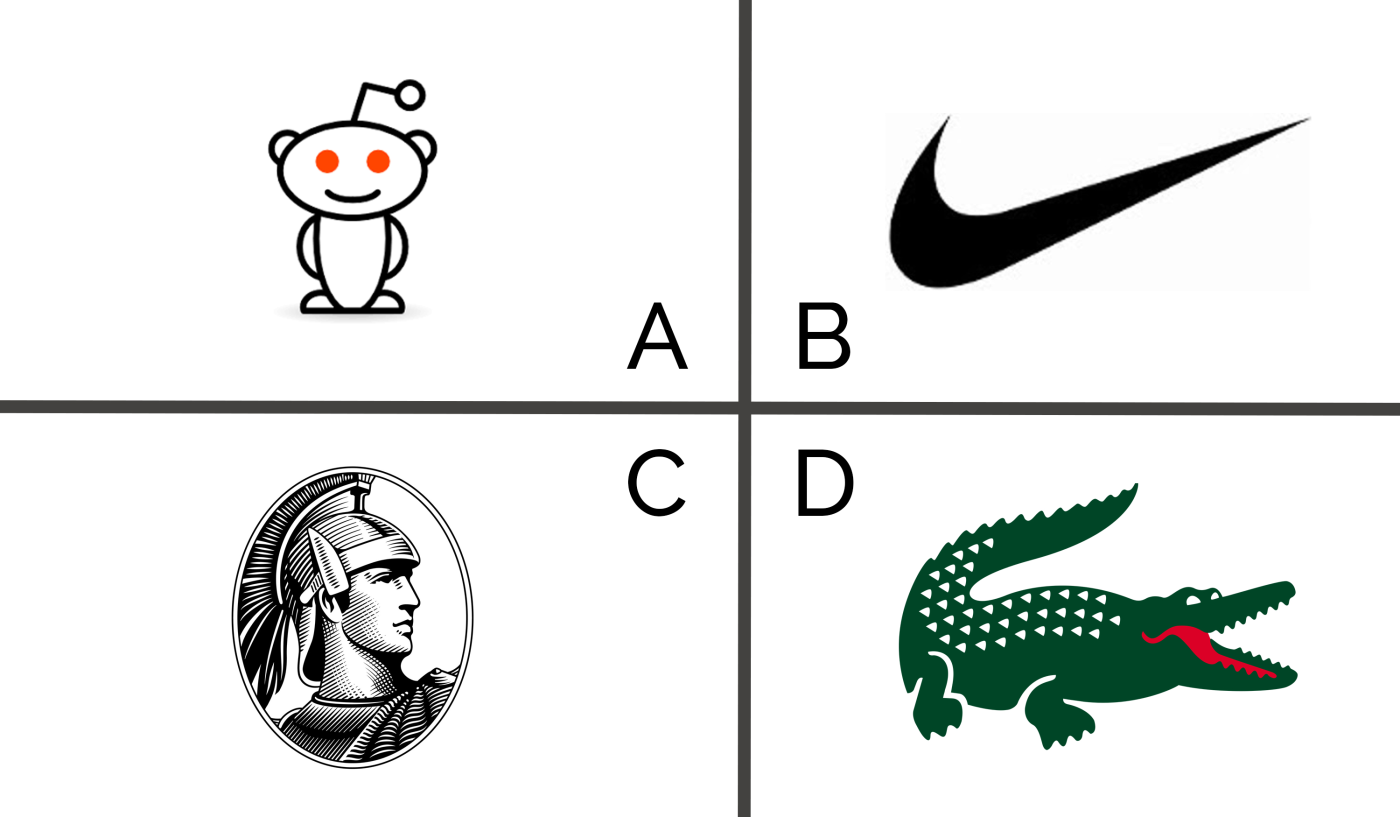
Logos—yes, you could be talking about the philosophical notion describing the principle of order of knowledge. But, in this case, we are talking marketing. Let’s do a quick quiz. Are you ready for a fun test of your observation skills?  In the boxes below, I show you four logos. Can you identify the companies below?

 (Click here for the answers.)

How did you do?  Differentiating yourself (your brand promise) is critical to business survival. So is communicating the benefits of your brand. Institutions are businesses, but rarely do our logos tell a story about our promise and what makes our school stand out from others. Research on brand logos suggests they offer a viable, albeit often neglected, way to help brand managers achieve goals around distinction and the story of promise. 

According to research by Park, Eisingerich, and Pol, logos have three very powerful roles. They are (a) integrators, (b) reflectors, and (c) synthesizers.

First, your logo is the integrator of your marketing efforts of the brand. It ties everything together. No matter your channel of communication, your logo is always there. It is the unwavering icon of your business. When enrollmentFUEL sends anything out to the public, our logo is the driver of our brand. It’s on Boost emails, our Octane magazine, mircoSEARCH™ mailings, and our famous Brainstorming Kits. 

Next, your logo is a reflector of your efforts. Let’s use the enrollmentFUEL logo on this litmus test. 

Higher Ed Marketing & Student Search Services | enrollmentFUEL

It is the icon of what the brand means to you, our customers. When I visit campuses around the nation, I am told by marketing and admission VPs that you recognize our brand, our marketing materials, and that we stand out. Thank you for loving Octane. It has become an integral part of our ecosystem as a community of thought leaders in the industry. (And, secretly, I love seeing them sitting on desks in your office. Are you staging those for my visit?)

Our colors are reflective of a vibrant company. The colors in the logo above have meaning. (If you are interested to learn about the impact of colors, this is a great resource.) Our base color is sable. This is our version of black, which stands for power and authority. Black also represents sophistication. And while we perceive FUEL as “funky and edgy,” our content is always geared to a sophisticated audience of readers—YOU. Our second color above is Aquarium; this is our blue. Blue represents security and trust. These colors are important, as they promote a feeling of security in your choice to partner with enrollmentFUEL for your Student Search and Strategic Enrollment Management needs. 100% of our client-partners indicated in our most recent independently-sourced satisfaction survey that you trust enrollmentFUEL.

We have two additional colors in our logo—New Green and Kumquat. New Green is the green swoosh in our logo, and Kumquat is the orange. Green indicates growth and harmony. This was an important color choice because growth represents success—and everyone wants to partner with a company witnessing success. Harmony aligns with two of our core values—Genuine and Love. So, it was also an easy choice to select green as a color. 

And, we save the best for last—Kumquat. Again, this is enrollmentFUEL’s orange. Of all the colors in our logo palette, enrollmentFUEL uses this one the most. It represents stimulation and energy. These words carry so much meaning for us because it’s our job to stimulate your enrollment growth, stimulate your curiosity as continuous learners in the field, and stimulate you and your staff with training and professional development as a teaching and learning organization. And, we have to do all of this with energy and excitement. For those of you who are client-partners, you already know about enrollmentFUEL’s energy level as we work together on Student Search, digital marketing, and financial aid campaigns.

Lastly, a logo serves as a synthesizer. It helps your future customers (students and parents) identify your institution and stand out against the competition. It further helps them understand your differentiators and any positive associations from your marketing efforts.

When we designed our logo, the synthesis part of the equation was perhaps the most imperative of all the features. With that in mind, we wanted to ensure the logo had meaning. I encourage you to look at the logo again.

Higher Ed Marketing & Student Search Services | enrollmentFUEL

Look closely at the gauge. What do you see? I bet you see two circles with little legs on them. Actually, these represent two “talk bubbles.” They suggest active communication and an accessibility for idea exchange. The center gauge is a nod to our ability and passion to provide measurable results. Generally, when one thinks of fuel (gasoline or diesel), one wants to have a full tank. In everyday life, a full tank represents a safety net for going the long distance. Our gauge was intended to elicit the same feelings. The needle indicates enrollmentFUEL keeping your tank full—both professionally (enrollment goals) and personally (your mental tank) for the long distance.

In closing, the research by Park, Eisingerich, and Pol on logos shows they carry great power symbolically, functionally, and in terms of sensory benefits. Surprisingly, few businesses (including institutions) trade upon the opportunities logos represent. Sadly, they simply fall short in visually expressing the brand’s values and principles. Logos have significant impact on a customer’s commitment, which in turn can move performance in terms of revenue and profit. If you haven’t taken time to assess the power of your logo in helping you meet goals in terms of intuitional distinction and the power of your promise, it might be time to revisit this small but iconic part of your brand.

C. Whan Park, A. B. Eisingerich and G. Pol. The Power of a Good Logo. MIT Sloan Management Review. October 2013.

Lessons in Higher Ed Leadership

Higher Ed Marketing & Student Search Services | enrollmentFUEL | group of professionals studying a wall of sticky notes

Lessons in Higher Ed Leadership

I remember the day clearly. I was scheduled to meet with my boss in half an hour, and I sat in my colleague’s office giving myself a pep talk. “I’m just going to tell her that my workload is too big to take on this major project. I have a stack of applications to review, I’m way behind on phone calls, and I have four campus visits this week!” My colleague nodded in agreement. “Yes,” she said, “just tell her what you think and that you’re concerned. I’m sure she’ll understand.”

I took a deep breath and walked down the creaky wooden hall. The admission office of our small, rural campus was in a building that was more than 100 years old. It was beautiful, though a bit creepy at night, as it was supposedly haunted. Our team of four admission counselors experienced the rare circumstance of reporting directly to our division’s Vice President. It was intimidating… or rather, I myself was intimidated. While this woman was friendly, she was also tenacious, like a bulldog. She had an incredible work ethic and seemed to be successful at pretty much everything she tried. There was no “give up” in her. She was in her office before we came in each day, and was often there after we left.

Due to a recent turnover in staff, I had taken on campus visit scheduling and event planning in addition to my counselor role. Now, my boss had asked me to spearhead a conference on our campus for every 11th grader in the county, complete with rotating sessions and presenters from both in and outside of the College. It took months to prepare, and it was a logistical mammoth—especially to me, a young professional who barely had two years of admission experience under her belt. After considering her request for me to take on this role, I decided to tell her, much to my chagrin, that I just couldn’t do it—I didn’t have time, and I didn’t want to try something this important and possibly let her, and everyone else in the county, down. It seemed like a reasonable enough request.

She patiently looked at me, and then very matter-of-factly said, “I understand. But if you want to move up, in any job or any aspect of your life, you have to be willing to take on more than what you currently have on your plate. Otherwise, you’ll always stay at the exact same place you are now. The employee time tracking app doesn’t really show anything worth of attention.” She kept talking, but I really don’t know what she said after that. When I later saw my colleague, she asked how it went. “I agreed to organize the conference,” I said in wonder, “and somehow she convinced me that it’s a really good idea…”

I now realize that a good leader has that effect. They push you, help you, encourage you, and sometimes hold your feet to the fire. As I look back on her example of leadership, I see how the lessons she taught me then have shaped the person I’ve become now.

That being said, here are five lessons in leadership that stood out, and tips on how you can use them to enhance your own leadership skills.

A good leader pushes you. Taking on a new responsibility was not something I wanted to do. But as a young professional, I didn’t realize it was something I needed to do in order to keep growing and advancing. She not only saw potential in me to take on this new role and excel, but she was also willing to speak truth to me in an encouraging way (more on that later). Ask yourself: Think of yourself as a leader—do you delegate well? Do you pay attention to see how your staff can grow, and if so, do you push them to pursue those opportunities?

A good leader leads by example. One day our team walked across campus for a meeting. As we walked under the huge, ancient elm trees (literally– these trees are close to 200 years old, and they’re amazing) we noticed a few stray sticks littering the sidewalk. She bent down as she walked by, picked up the sticks, and tossed them off the path. “Always be a good steward,” she said. “It’s everyone’s job to take care of campus.” That simple action has had a tremendous impact on me. Nowadays when I walk around my building, I stop to straighten up or tidy things that are amiss. That lesson continues to pour into my life, whether I’m walking in my neighborhood and see trash, or attending a church service and notice a mess. It’s something I say to my own children: Be a good steward. Taking care of our environment is everyone’s job. Ask yourself: Do you model the small behaviors you want to see in your staff and on your team? It’s easy to get caught up in the busyness of life and leave the smaller things for someone else to do. Be the change you want to see, and those around you will follow suit.

A good leader helps you learn to solve your own problems. If her door was open, it meant she was available to us to stop by. It wasn’t unusual for one of the counselors to be in her office at least once a day, usually to review a particular application that stumped us. I learned early on that she was glad to help us—after we first tried to help ourselves. When we brought a problem to her, it was expected that we also brought 1-2 potential solutions. “Don’t just bring me a problem,” she’d say. “Bring me a solution!” She helped shape the way I think through every problem in my life, not just at work. Even if the solution I started with wasn’t the best one, it helped steer the conversation, and we kept talking until the right answer was discovered.  Ask yourself: When your team brings you a problem, do you jump in and solve it for them? Look for opportunities to help them learn how to figure it out themselves.

A good leader speaks truth to you. At the end of one of my performance evaluations, she said “You’re really good at the ‘stuff’ of admission. The files, the events, the college fairs… you excel in these areas. But be careful not to get so wrapped up in the ‘stuff’ that you forget about the people. It’s the people who matter. If you forget about people, one day you’ll look up and have all your ‘stuff,’ but people will be gone.” Was that a sobering thing to hear? Yes. Did it stick with me? Absolutely. A good leader doesn’t shy away from being honest, no matter how tough it may be. Ask yourself: Do you tiptoe around hard conversations, or take the long way around to explain a point, rather than being straightforward? Are you willing to speak the truth to your team—whether it’s popular or not?

As a good leader advances up the ladder, they turn around regularly to check on you and your progress. As she got involved in professional associations, she asked me if I would be interested in presenting a session. After learning from lesson #1 (a good leader pushes you) I said, “yes”—and my session was selected for a regional conference. Five years later, I’ve presented eight times at the state, regional, and national levels. I’ve served as a committee chair at both the regional and national levels.  I never would have set these goals for myself, but saying “yes” to opportunity has provided growth in many areas. Ask yourself: As you advance in your career, do you check on your entry and mid-level employees and encourage them to step out and try something completely new? There may be someone waiting for a chance to shine if only given the chance.

We now work at different places, but my boss ultimately became my mentor, and my friend. She continues to find ways to help me grow, and is always available as a resource and guide. Thanks to her, I have the confidence to be my own problem solver. And thanks to her, I’m open to taking on new challenges, because I now see them as opportunities for growth. It turns out the little, and big, things make a great difference both in leadership and in life.

by Becky Tankersley