Your Domain Reputation Affects Email Deliverability

image of various icons in relation to mail and email | Higher Ed Email Marketing | enrollmentFUEL | SEM Articles

Your Domain Reputation Affects Email Deliverability

Your school’s domain name has a reputation score. Scores are calculated based on online metrics in various areas, including reviews, social, surveys, reach, and email open rates. Maintaining a “good” score has become more critical in recent years because machine-learning and algorithms can impact email delivery rates. When an institution has a good email reputation score, emails get delivered. When an institution’s score slides into below-average territory, emails can be prevented from reaching mailboxes, causing Student Search campaigns to perform poorly.

So what’s the problem? Old habits that once led to success can now create issues.

For years, many enrollment leaders started their annual Student Search efforts by emailing large audiences of cold leads (non-responders) leftover from previous efforts. For awhile, this worked well or well enough, or at least caused no harm. But ballooning volumes of spam forced email providers, like Gmail, to adapt technical infrastructures to limit customer frustration. Today, when you send emails that are not opened, the action triggers artificial intelligence (AI) warning signals. When the percentage of unopened emails exceeds a defined algorithmic threshold, you are in danger of being labeled as a potential spammer, which lowers your reputation score and impacts future email deliverability to new audiences.

Past practices developed by well-intentioned enrollment leaders and consultants were shaped in a much different environment. Like everyone else, I was once a believer in starting Student Search efforts with the treasure chest of free names from last year’s “non-responder” list. The non-responder list was often huge—particularly if a school had over-purchased names based on the theory that more names meant more freshman students. No one worried about a domain’s reputation or how an institution could be affected (or even severely impacted) by complex algorithms or brand strength in this bygone era.

Long before I started enrollmentFUEL, I had started to question whether schools were purchasing too many names. I’ve enjoyed numerous discussions and have written many words about stuffing the top of the funnel with leads. I call this technique the “gravity” strategy, where many institutions hope that the force of gravity will push enough names through the funnel and ultimately meet the numbers goal for the incoming class. This solution seemed problematic in many ways, mainly since many schools had tight budgets and limited resources. A targeted approach, where you focus recruiting efforts on the leads most likely to convert, seemed to make more sense, and I focused on developing this strategy.

When I started enrollmentFUEL, I had the opportunity to put new strategies and best practices into action on our very first client, a rural midwestern university. Both the vice president and dean were new on the scene. They discovered that almost 200,000 names had been purchased the previous year. Starting with this list, I worked with one of enrollmentFUEL’s geodemographic research partners to help us find the best 50,000 leads from the larger list, and that was where our Search campaign started. Back then, the strategy got good results. Today, I would make adjustments in the same situation because emailing non-engagers is a far riskier business.

Let’s focus on some best practices and tactics to improve email open-rates in general, so you can ensure your new name purchases have their best chance to reach inboxes and generate inquiries.

Start with a good list. This will be more challenging in the future as more schools become test-optional and fewer students take college entrance tests. With fewer names available from traditional sources, you may be looking for alternative lists. Be selective when pursuing new sources. One alternative to explore is look-alike modeling combined with digital display advertising and a technology tool like enrollmentFUEL’s matchBACK to generate a new source of leads.

Batch names and send your first emails to students who are likely to be familiar with your institution, like the students who are close geographically. As a known “brand,” you are more likely to get a favorable response to your emails, and opened emails send the right signal to algorithmic controllers.

If you absolutely feel you must go after non-responders one more time, start with a different channel than email. Banner ads or direct mail are both excellent alternatives. They introduce your brand, prime your audience, and open the door for a follow-up email (preferably sent in small batches so you can gauge performance).

I love mail, digital banner ads, social advertising, and email. They all have their uses, and when you combine them in a Student Search campaign, they are powerful.

Email lets you measure engagement, and it isn’t going away anytime that I can see. It also is the channel that helps you measure the impact of mail and digital advertising because when mail and digital ads have done their job, emails are more likely to be opened.

For your emails to be delivered, you need a plan to monitor your online reputation because emails from schools with strong reputations will reach inboxes. If you want help assessing your reputation score, talk to a member of the enrollmentFUEL team. We have plenty of ideas to share on how you can monitor, protect, and improve your online reputation because a good reputation does matter.


The Tapestry That Is the University: New Weavings in Higher Education

image of person using a television remote | Higher Ed Marketing & Student Search Services | enrollmentFUEL

The Tapestry That Is the University: New Weavings in Higher Education

Loughborough University, United Kingdom, April 5, 2016—Dr. Jacquelyn “Jacqui” D. Elliott recently presented at the 2016 Student Records Officer Conference (SROC). There, she discussed the changing landscape of universities–what she calls “tapestries”, and the challenges higher education professionals face through adoption or rejection of policy, which affects the “weavings” that often become the accepted culture of higher education. Her discussion further highlighted many of the similarities faced by global higher education professionals, to include limited resources, financial downturns, and dynamic changes in technology. So what was her main takeaway? Each person on a university campus is responsible for his or her own thread, and how that thread weaves the tapestry that is the face of the university.

Whether in the UK, or the US, finances are often the biggest hurdle colleges and universities face. And, students often experience mounting financial barriers in the enrollment process, since many institutional policies demand more forms than actually required by US state and federal governments. This additional minutia creates the possibility of a student not even enrolling in college because of the hurdles placed before them. This, in turn, affects the reputation of a university through convoluted customer service. Additionally, tuition costs for education have become exorbitant across the globe. The UK has experienced tuition caps at £9,000, similar to many state-imposed tuition freezes in the US. Areas for possible reduction include redundant staffing or bloated policies that create more work, take up more resources, and clutter-up the landscape of higher education. This affects both the staff and students degrading the richly woven fabric of universities.

Another difficulty facing administrators is keeping up-to-date with the rapidly changing advancements in technology used in today’s society. Jacqui explains how much the current trends have changed:

“When we started, there was no Facebook, Twitter was a sound, 4G was a parking place, the cloud was something that made us pack an umbrella for work, LinkedIn was a prison and Skype was a typo.”

These advanced technical solutions and applications are an expectation for those paying premium tuitions. As higher education administrators, technology offers a way to streamline outdated processes that keep universities moving forward and globally connected to students, ultimately, creating the new fabric of higher learning.

So what can be done to keep the tapestry from unraveling? Simplicity. Make administrative processes clear. Allow students easy access to the knowledge and services they seek. Limit the amount of student debt incurred, and help launch students into the workplace with applicable skills that will help them in their future work environments.

3 Waves Effective Enrollment Leaders Ride

image of various icons centering around a main icon of a graduation cap | Higher Ed Digital Marketing & Student Search Services | enrollmentFUEL

3 Waves Effective Enrollment Leaders Ride

I’ve always been an early adopter. I always tried to do things first. In the sixth grade, I was one of the first to part my hair down the middle, and in high school, I was one of first to add a power booster in the trunk of my car to amplify sound. In college, I was one of the first to play Michael Jackson’s dance moves over and over on my VCR teaching myself how to moon walk across a dance floor.

All of these things are embarrassing to admit. They clearly identify me as a child of the 1980s. And yes, I graduated high school sporting a big mullet hair cut and was quite proud of my collection, at the time, of 8 track tapes that I could blast from my car.

Today, I’m referred to sometimes as the big idea guy. I like to run to the new thing and fully engage it early. I admit that I do this because I’m kind of imagining that I’m shouting back to the crowd “look everybody, this is where things are headed.”

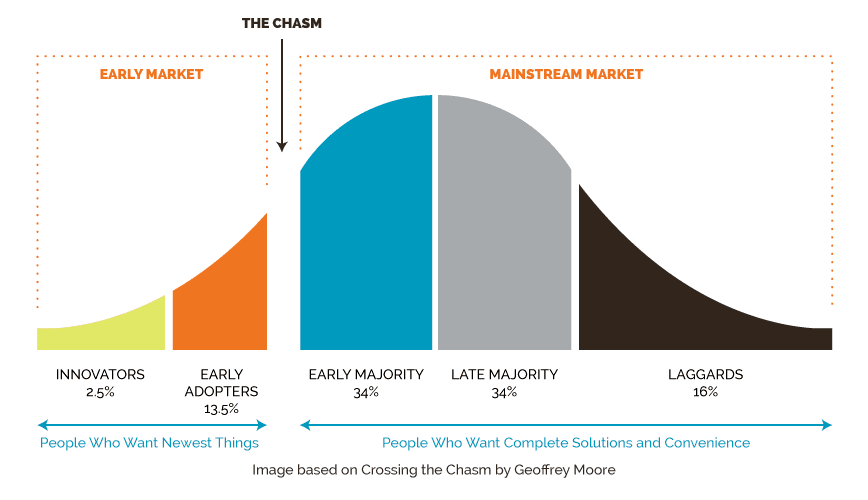
I was fascinated many years ago by the book Crossing the Chasm: Inside the Tornado by author Geoffrey Moore. He studies the Diffusion of Innovation Theory developed in 1962 by Everett Rogers—a standard bell curve distribution of how technology is advanced by populations. Some of us at one end of the spectrum are innovators and early adopters, while at the other end of the spectrum, there are the laggards. I’ve engaged the laggards much of my life and have tried to change them. I have learned that whenever championing change, it’s better instead to focus on the center of the bell curve.

Based on Roger’s model, I know I will never be a pure innovator, which represents only 2.5 percent of the population. Instead, I’m a proud member of the “early adopter” group, which represents 13.5 percent of the population. This group generally hops on the bandwagon before others. And, we often hop off of the same bandwagon a little too early, as well.

Today, I want to encourage you to try to ride some waves a little longer. I have identified three waves that many successful enrollment leaders are riding today; and, many of you are still paddling in the surf looking for the next wave to hop upon. Riding these waves could possibly pay huge dividends for you.

I liken this phenomena as similar to something we all do. We leave our queue for another when we’re checking out at any national big box retailer in hopes of finding a faster line. Often, we find if only we had just remained where we were initially, we would have been satisfied with how our line ultimately started moving. Some things in life require us to “stay in line” and continue riding waves that keep producing.

One wave that I’ve learned to ride as long as possible is direct mail. Recently, I was strategizing with direct mail industry expert Kathy Wise, of DME, on their campus in Daytona Beach, Florida. In a round table discussion, with many of her thought leaders, we were all admitting to being early adopters, who had experienced hopping off the wave we were riding too soon. We all identified with wishing we had stayed on some waves longer to benefit from them being embraced by more people.

There’s a chasm here according to Moore. It’s tough for many to hang around—because we think there is something better just over the horizon. This chasm is hard for many to cross. But, it’s usually where 68% of the majority operate, and it’s the hallowed ground where I want to encourage you to remain longer than you may be accustomed to staying.

Recently, I visited 8 different campuses in the state of Ohio. This is a state that gives you plenty of time for reflection. I spent a lot of time in my rental car thinking—“what just happened back there?” Some of my thoughts were “did I just hear them correctly in that meeting?”

I was amazed at how many campus leaders are simply looking for a magic pill of sorts. Many people only have their head up for the next wave they can ride. One enrollment leader asked me to circle back with him after I visited all the schools on my Ohio agenda and let him know if any school had found some kind of magic potion not yet known to them. If there was one, he shared, he’d surely be interested in talking again. What I discovered was what I already knew—such a potion does not exist. What does the trick is a solid plan, hard work, and dedication to seeing through the smallest of details.

There are some magic potions that many are hearing about in higher education communications. Some of the magic potions in the current enrollment communications landscape include some of the very technologies offered by enrollmentFUEL, so I warn many clients that these technologies cannot take the place of hard work.

Sometimes it’s great to be an early adopter. We need people who can recognize the future. But we all need to pay attention to the bell curve—it highlights for us what really works.

One thing that I’ve talked about recently is how I’ve fallen in love all over again with email. This is a wave that I was ready to leave. Spam filters and gray listing had made this channel difficult to navigate. But, let’s just say that email has worked it out. And, I like it. I like it most when combined with the second wave that successful enrollment leaders continue to ride—high impact direct mail.

The kind of mail I’m talking about is high impact mail. High-octane mail…as I sometimes call it. Sometimes, it’s the size, other times it’s the way it feels to touch, or even how it smells. Often, it’s inviting because it is a box or package of some sort. The real power of mail is that it can stay around for months and continues to impact in ways that are difficult for marketers to measure.

In the company that I lead, enrollmentFUEL, I think we’re early adopters. Most of us understand the power of mail very well. We do some pretty cool stuff with mail. Direct mail is a hard worker that is favored by those who aren’t scared of the hard work required to be successful.

Direct mail is espoused fully by groups representing the early and late majority in the graph above. 68 percent of you know this! And, if you know this, you’re probably an enrollment leader who is having success. What you probably know is that most Americans each day have what I call the “mail moment.” A moment each day that is a brief respite—a time when we pause fully and allow one communication channel to completely interrupt our day and capture our undivided attention. Independent research provided to the USPS indicates that 98% of Americans ritually have this pause in life each day. Almost all Americans have a sacred time each day where they let this hard working channel interrupt their hurried lives.

Mail is steady. It’s reliable. It gets to parents. And some weird early adopters like myself even like the way it feels and smells. (There are many special things you can do to make it feel good).

But, hard work is not as popular as emerging technologies. And, mail is not as sexy as Instagram, to some.

I tell most prospective clients at our company, FUEL, we have nearly any technology that any early adopter could be considering. We are inbound marketing experts. We pre-target, re-target, data mine, and score behaviors on a weekly basis. I like to get updates on where the technology with Near Field Communications (NFC) is because I have a personal interest in it, and because I think it can be a game changer—as I already told you, I’m an early adopter.

(Keep your ears up for NFC… it could be the next big thing.)

If you’re one who’s thrown out mail in your strategies and have may considered it obsolete—it’s time to start looking at how you can integrate it with those shiny technologies that currently impress you. Mail also has the uncanny ability of playing nicely with other technologies.

Mail is the piece that hangs around on the kitchen table. It contains the personalized URL. It sometimes contains the QR code—which is technology that many have moved away from too soon and is seeing resurgence. Mail allows you to harvest the seeds you’ve sown with your pre-targeting and re-targeting banner and other inbound marketing strategies. Mail is given permission to interrupt. And, it is allowed to stay around longer.

And moms like mail. Need I say more?

I caution clients after I’ve impressed them with technology that it alone cannot fix their problems. It is why two thirds of all CRM software implementations are considered failures and don’t provide the magic leaders were envisioning. The next time you’re Googling out of boredom, enter in “CRM and failure.”

I have a saying that I’ve borrowed from our Monmouth College client, Vice President of Enrollment, Trent Gilbert. Trent shared in an early meeting that most things in Enrollment Management involve “people recruiting people.” When Trent says this, his towering voice also adds matter-of-factly, “they always have, and they always will.”

There are no magic formulas. Hard, persistent work is still necessary to be successful in any setting. I consider email a hard worker. I think mail works even harder. But none of these is an important to your success as the hard work of your people.

Too often this year, I’ve seen schools that were busy, but they weren’t working effectively. Some of them are busy jumping from one wave to another. Successful enrollment leaders know which waves to ride, and one of the best waves to ride is what the DME team calls the “ruthless elimination of unqualified leads.” It takes smart, hard, work to have the courage and strategy in place to let your people spend their time on those most likely to enroll, while eliminating those prospects that you’re romanticizing about impressing, but they’re essentially wasting your time and money.

Hard work is a wave that needs to be ridden for a long time. It’s a timeless absolute.

Where do you fall on Roger’s spectrum of his “diffusion of innovation theory?”

Engaging the shiny and new do not always provide outcomes that are sustainable. Just look around and tell me how the mullet hairstyle is received today. Laggards are chasing the past and are quick to give up and say the sky is falling. Sometimes, equally as dangerous, is an early adopter who jumps to every new shiny thing.

What really works is hard work, and there is no magic formula that I’ve found on any campus I have recently visited in Ohio, Pennsylvania, Maryland, West Virginia, Kentucky, or Virginia. I still have many states to go, but I doubt I will find a silver bullet there, either.

Coaching Parents on Financial Aid Conversations

Higher Ed Marketing & Student Search Services | enrollmentFUEL | image of a sticky note with the words "financial aid" written on it

Coaching Parents on Financial Aid Conversations

As financial aid and admission counselors, who would have ever thought we would be coaching parents on the conversations they have with their students about college finance? Don’t we have enough to do just to get the financial aid in their hands? And, wouldn’t you expect the family unit to be in cahoots on these conversations about the finances of attending college?

In her book, Indebted[1], Caitlin Zaloom interviewed parents about their resistance to talking to students about their financial status. Many said it “just feels weird talking about all this with my teenager.” Seemingly, parents don’t want their kids to feel like a burden, even if it is obvious that debt and a stretched financial pocketbook are looming. And, it isn’t just the parents at fault here—rarely do teenagers push to find answers or ask the hard questions. Zaloom calls these actions and reactions “nested silences.” So, how do we professionally help parents and students move away from nested silences to vested conversations? Here are five great coaching tips to arm you.

While parents talk to their students about a lot of things that were taboo just a generation ago—like mental health, the complexities of sexuality, and bullying, finances still remain “hush hush.” A 2019 study from Experian[2] says that of 18-19-year olds, only 58 percent say their parents are financial role models, and an additional 46% say they have unanswered questions about money and feel “uncertain” and “nervous” about their own financial future. 

Coaching Tip: Talk with your parents about how these nested silences are actually counterproductive and don’t help students feel safe, but rather the opposite. Cite research like the numbers above, or even better, share a copy of Experian’s research with families as a “takeaway” from your office.

When it comes to social postings, most people want others to see them a certain way that is largely over-exaggerated. Most people post on social media the lavish vacations, new cars, or fancy gadgets they have purchased (mostly on credit), but the psychology of this doesn’t stop students from forming a false sense of reality. 

Coaching Tip: Give parents a list of educational electronic outlets like Niche, Higher Ed Geek, or Higher Ed, Not Debt to help correct the realities of finance. This is also the perfect time to talk to parents and students, together, about a budget. Prepare your own budget sheets and give them out, widely. Spend some time in your office talking with families about both savings and debt as you walk through the budget. Help parents feel safe letting their students know debt is okay for the right kinds of purchases. Debt isn’t scary if couched in value. Help parents and students understand the value of higher education. But, be prepared with your value statements.

Many students are behind in their financial literacy. Why? Because most families are not excited to share their earnings with students. That’s okay. Remember, our students need to be focused more on financial concepts like saving, budgeting, paying down debt, and charitable giving.

Coaching Tip: On the most basic level, encourage parents to teach their rising college students to use an app like EveryDollar. This handy tool allows teenagers to track spending habits and see just how far their money is going. Soon, establishing a budget will feel like second nature. If they stick with it, by the time they get to your campus, they will be ready to face the realities of operating within their budget.  

If you are really aggressive, consider creating a financial literacy seminar for rising freshmen. It could be as simple as a six-week course where students log in for handouts, blogs, explainer videos, and chat sessions with professionals from your office. Remember, the offer of the service will go a long way psychologically and be a distinctive to your campus in terms of the value proposition, even if students and families don’t “stay with it.” (As an analogy, remember the open house you visited and smelled fresh chocolate chip cookies when you walked in? While there weren’t any cookies in the house, the smell made you feel like this place was home, and it stuck with you!)

It’s important to find the balance in financial conversations about reality and pressure. Of course, parents don’t want to put undue pressure on their students about the cost of college and the struggles they may face. Remember, many high school students are motivated enough, so heaping pressure on high performance isn’t going to make that much difference if the student has a 3.8 GPA.  

Coaching Tip: Don’t let merit aid be a secret. Counsel families and students about what a realistic next bracket might mean in terms of money. For example, if you use a matrix-based award system, and the student has a 3.2 earning $7,000 per year, share with them that if they can get their GPA up to a 3.3, their scholarship would go to $8,500 per year, an additional $6,000 over four years for just a little extra push in the classroom. Always coach the family to frame the conversation around opportunity—the excitement they have about what the family money can do to help the student afford his or her education.

Because of the way our financial aid system works at the national level, it’s important to help parents keep conversations about finance going after the freshman year. The conversation doesn’t stop after the student matriculates. 

Coaching Tip: While it may seem obvious to us on this side of the desk because we do it for a living, many families are not aware they have to file every year. Educate families and students in conversation about this fact. Create a check-list of things you want to talk to families about in your counseling session. Prepare an actual “agenda” for the meeting. Trust me—this sounds like overkill, but when a family experiences that you have prepared something special for their meeting, it will make you stand out from other schools. Remember value propositions? When paying a large price tag, these small things really add up in the campus visit. They help you be distinctive, and the value for the dollar is evidenced from the first interaction a family has with your school. Even better, the family will leave with their copy of the agenda with notes in hand, so the effect is long-lasting as they pull that out as a reference, later.

In closing, one of the best coaching tips is to ask families right out the gate, “What’s your vision for paying for college?” This allows families to speak more broadly about what they want –and can afford—to contribute without putting expectations on them. This question helps open vested conversations and shatters nested silences. And, just think—if you employ the coaching tips from this blog, you will provide families with research handouts, a list of educational blogs for students, a value proposition that holds up, financial literacy information, a budget tool for students, a realistic expectation about “grades for dollars” and a meeting agenda of talking points that will set your counseling session apart from other schools. Vested conversations for the win!

[1] ZALOOM, CAITLIN. 2021. INDEBTED: how families make college work at any cost. [S.l.]: PRINCETON UNIVERSITY PRESS.

[2] Taken from: Survey: Generation Z Keen on Learning About Personal Finance and Credit – Experian

Leveraging AI: Creative Photography & Videography in Higher Education

Higher Ed Marketing & Student Search Services | enrollmentFUEL | AI

Leveraging AI: Creative Photography & Videography in Higher Education

Mention the term Artificial Intelligence, commonly referred to as AI, to anyone today, and their reaction will probably go one of two ways: giddy excitement at the thought of a fully automated and online world, or, if you’re like me, wary skepticism with at least a hint of fear concerning what AI means for creatives and intellectual property (IP). Before we embark on this AI-powered adventure, we must acknowledge the mixed reactions surrounding artificial intelligence.

Some greet AI with open arms, seeing its potential to revolutionize our world, while others, like this cautious author, approach it with skepticism. Nevertheless, AI has already begun to make its mark in academia. Academic integrity is a key pillar of higher education, and students submitting essays created by programs like ChatGPT have caused chaos. However, an overlooked aspect of AI lies in its photo editing capabilities. We’re going to dive into the fascinating world of AI and its game-changing potential in the realm of photography and videography within universities and colleges. 

Acknowledging the difference between photo editing and photo creation is important. One common misconception is that AI can flawlessly generate images from scratch, conjuring pictures like something from a science fiction movie. However, the reality is a bit less glamorous. 

Prompt an AI program to generate an entirely new image, and you’re likely to receive an image that looks like a still from an early 2000s video game. Uncanny faces, poorly rendered, CGI-looking backgrounds, incorrect perspectives, and perhaps most telling of all—the hands. If anyone needs a quick way to determine whether a photo was AI-generated, simply look at the subject’s hands: they’re bound to be missing a finger or two or have entirely too many. 

As AI draws from existing images to generate its output, copyright and IP issues have been increasingly common. Last month, Washington, D.C. U.S. District Court Judge Beryl A. Howell ruled that nonhuman, AI-created work cannot be copyrighted, which was a major win for artists and creatives.1

While AI might not be the virtuoso image creator we envision, it can excel as a photo editor. Adobe Photoshop’s updated Generative Fill is particularly useful. 

Applications in Higher Education

Let’s explore how you can harness Generative Fill for practical and innovative purposes while maintaining academic integrity and avoiding copyright concerns. Here’s where the magic happens: need a background changed or expanded? Done with a click. Want to change the glass of water you’re holding into a steaming cup of coffee for the ultimate cozy picture? Easy peasy. Think a photo of campus would look great with a cute dog on the lawn? Prompt Photoshop to add one, and you’ll even be able to choose the breed and pose. 

The uses for such a feature in the higher education sphere are endless and can cut down on workloads for designers and marketers. Now, let’s get to the exciting part—how universities and colleges can leverage this AI powerhouse for creative purposes:

EFFORTLESS DESIGN TWEAKS
Designers and marketers rejoice! Instead of laboriously isolating subjects and resizing backgrounds, Generative Fill enables quick background expansion while keeping the subject crisp and clear. 

VERSATILE MARKETING
Picture this: You have just a handful of high-quality student photos, but you need them to represent various campus settings. AI can seamlessly transport them to residence halls, lush campus courtyards, bustling dining halls, or engaging classrooms.

DYNAMIC AD CAMPAIGNS
Say goodbye to static images. By generating different backgrounds and turning them into GIFs or stop-motion videos, you can create attention-grabbing clips for social media advertising. Imagine a student appearing to study in various campus locations in a single video—that’s the power of AI-driven storytelling.

Skepticism about AI and how it might impact academic and creative integrity in higher education is not unwarranted or even unwise. That said, navigating AI with cautious optimism could give your institution’s recruitment marketing just the edge you’ve been looking for. Recognizing AI’s potential to streamline creative workflows and judiciously applying AI can allow institutions to greatly enhance their visual content creation while saving designers and marketers time and effort. So, embrace AI as your “creative assistant,” and let your institution’s creativity flow freely!

1Retrieved from: https://www.reuters.com/legal/ai-generated-art-cannot-receive-copyrights-us-court-says-2023-08-21/ 

Top 5 Digital Marketing Tips for Higher Education

image of person using a laptop surrounded by icons in relation to digital marketing | Higher Ed Marketing & Student Search Services | enrollmentFUEL

Top 5 Digital Marketing Tips for Higher Education

Increasing enrollment is at the heart of every marketing goal in the higher education world.  Seems like an easy enough task, right? 

In the ever-expanding digital world, it often feels harder than it looks. Fear not; we are here to help!

The opportunities digital marketing holds can be fantastic but overwhelming at times. The sheer volume of advertising platforms available makes it difficult to choose where to advertise, let alone who exactly should be seeing your ads.  

Being able to target specific groups of people is key for institutions looking to increase enrollment numbers. Targeted ads can be broadcast across: 

  • Search engines such as Google
  • Social media platforms like Instagram, TikTok, LinkedIn, and Facebook
  • On TV through streaming services such as Hulu 

The more you’re able to narrow down your target audience, the better your chances of successfully catching the eye of a new student or their parents.  

Factors such as age, household income, location, and job type are crucial categories to consider. Ad creative and copy tailored to your target demographic is a great way to draw in your desired audience. A targeted ad sent to households at a certain income level in zip codes near a popular feeder high school will generally be more effective than a more generic ad sent to an entire city. 

Strategic Search Engine Optimization (SEO) is vital to making sure your content reaches your target audience. When writing copy, selecting the right keywords, title tags, and meta descriptions helps increase search engine visibility and drive traffic to your school organically. 

Tools like Semrush and Google Keyword Planner can help you pinpoint those keywords and trends that relate to your school most, giving you a strong starting point for optimizing your content.

Effective SEO allows your school to show up at the top of search pages and reach a wider audience. A higher search engine ranking also increases brand visibility, audience trust, and clicks, which may lead to more applications! 

In today’s world, social media is used as both a community-sharing space and a search engine. If interested in a school, a high schooler may go to TikTok first to see what life looks like for current students before they go to Google. Having your school’s videos pop up at the top of the page is a significant advantage.

According to the 2023 Niche Juniors Survey, current students are most influential for students who are deciding which college to attend. Tapping into influencer marketing by hiring students to create TikTok or Instagram posts detailing their life at your school is a great way to have content that can grow organically over time, and bring a human element to your school’s marketing strategy. You may also want to hire student ambassadors to post to your social media channels. They’re adept at incorporating current trends, pop culture references, and visual styles to help foster a sense of community and relatability.  

Social media is the perfect space to showcase your school’s unique differentiators, highlight student life, and give a glimpse into what day-to-day life as a student on (or off) campus looks like. 

Your ad copy is ready to go, your target audience selected, and social media platforms picked out—but when previewing your ad, it looks pretty underwhelming. What happened?  

Optimizing your ad for mobile is critical for catching the viewer’s attention mid-scroll. Editing ad creative to fit the correct image size and resolution for each platform ensures legibility and image quality. In-feed ads on platforms, such as Instagram, should be full-size, high-quality images that visually communicate the atmosphere of your school. Short and sweet is best for headlines, and be sure to include your school’s logo somewhere in the image. 

Stuck on the design bit? Incorporating your school colors and images of real students and professors offers a succinct visual overview of what you are offering while still being brand-cohesive and fun! 

Fun designs and top-ranking keywords are great but would mean nothing without data analytics. Data informs who and where to target, what people are searching for, which ad designs perform best, what platform gets the most interaction, and so much more.  

Digital advertising data can be daunting, even overwhelming on the surface. However, understanding it and using it to make informed decisions is essential to any successful marketing campaign. Most platforms have their own analytics space with categorized breakdowns of your ad performance to help you navigate the data insights. Using this data to further tailor ads is a great way to narrow down target audiences and understand how to reach them better. Data is your friend, not foe!

What other top digital marketing tips do you have for higher education? We’d love to hear them!

In God We Trust—All Others Bring Data

image of various icons in relation to lists, data, and verification | Higher Ed Marketing & Student Search Services | enrollmentFUEL

In God We Trust—All Others Bring Data

I met with a client who we had helped reach a pretty significant enrollment milestone. Like so many of my clients actually, this client teaches me something new almost every time we meet. This lesson I had already learned over and over. Data is king!

Data is a pretty hot topic in many circles today. It’ s amazing what you can accomplish with good data. Those schools who do their data work ahead of time tend to set themselves apart from others schools. These model schools typically have a strong desire to look at the data while also having a passion for capturing and mining new data for future decisions.

This client was expressing the need that Vice Presidents of Enrollment Management bring data to the table anytime a new strategy was about to be launched. She reminisced about a time when her school president did not listen to her as much as he does today. She had tried to convince her president that a certain Student Search recruitment strategy would be the best course for the school to take as she was developing ways that her gut told her that her efforts needed to be both retooled and reengineered.

She remembers the meeting with the CFO and the president and how excited she was about trying some new methods in her Student recruitment strategies. But what she remembers most about the day is how he smiled and said “not yet,” on taking new bold measures to totally turn upside the strategy of replacing a high volume funnel type strategy with a philosophy that focused less on saturation mailings and volume name purchasing and more on getting high quality leads that were more likely to convert or matriculate to enrollment.

So what made the president finally acquiesce to the enrollment leaders way of thinking. It was the data.

“We have a saying on our campus that emanates from the president’s office: In God We Trust: everyone else bring data.”

She then found our geo-demographic research partner and starting using good old fashioned regression techniques learned in her graduate school statistics classes and she found a way to show the president that, less can be more, especially when it comes to building an inquiry pool that was going to lead to an increase in enrollment.

The client described above was one that fully embraced the ideals that make predictive modeling and geo-demography so fruitful for many. It makes me wonder why anyone would venture into Student Recruitment without good geo-demographic research leading the way.

Predictive Modeling allows you to build a better inquiry pool because you’re matching the inquiry to the university. A mistake that many make is that the student profile you’re going to be successful recruiting looks very different at different distances from the school. Students who enroll at your school in your tertiary drawing area (TDA) look very different from school who make up your primary drawing area (PDA) which is typically those 8–10 counties closest to your school. So don’t go to the middle of the country trying to find a student who looks like those on your urban campus living close by. Study what previous students who traveled from certain geographies looked like who enrolled in your school and go and find more students who appear similar. A better way to do this even is to have a profession analyst look at your data.

Recently I received pricing estimates from a name list provider for two different kinds of strategies to find students who possessed a certain kind of affinity. One way that I could proceed was to buy all the names for a school which accounted for a $174,000 expenditure. (Yes there are some schools that take the easy way out and buy all the names.) Another way included drilling down even more to where the list purchase cost $68,000 dollars. Yet another drilled into an area finding the exact students who were likely to matriculate to enrollment from that area with a certain interest for the small cost of $8,600.

Don’t think you can’t afford predictive modeling and geo-demographic research. You can’t afford not to use these techniques that provide rich data for the professional enrollment manager and allow you to win the trust of most college presidents who only trust the data.

If you’d like help with a free complimentary Geodemographic analysis of your current enrolling class email me at mike.wesner@enrollmentfuel.com.