The World of Email is Changing: What You Need to Know & Why

image of various icons in relation to mail and email | Higher Ed Email Marketing | enrollmentFUEL | SEM Articles

The World of Email is Changing: What You Need to Know & Why

To rephrase Mark Twain, the reports of email’s death have been greatly exaggerated—for now. It remains one of the most widely used marketing communication tools, especially when we talk about list marketing, which, in higher education, includes both the search strategy many of us employ to build up the top of the enrollment funnel, and any communication flows going to inquiries, applicants, or accepted students. 

In a year when the FAFSA filing deadline has been postponed and many colleges and universities are ramping up their student and parent communication to ensure everyone has the information they need, it is crucial to be aware of any changes happening in the world of email. 

In late 2023, Gmail released a number of product changes, which included account management. At the beginning of this year, email providers Gmail and Yahoo—with more expected to follow suit—announced the enforcement of spam and deliverability regulations that are likely to affect email marketing for years to come. As a teaching-learning organization, we wanted to bring you a summary of the above changes and the impact we anticipate them to have on higher education email communications.  

First and foremost, here is a summary of the upcoming changes and the ones that have already happened, along with some suggested actions you can take in response to them:

Gmail Changes on Account Deactivation

December 1, 2023, Gmail began deactivating any account that has been inactive for 2+ years. This move could affect a list-based email campaign’s ability to reach its audience if a certain number of the emails included in it have been deactivated. Emailing deactivated accounts will result in a higher percentage of bounce-backs, which, in return, could erode the email domain reputation, preventing emails from reaching active accounts.

Your Takeaway

Your marketing and communications team, as well as CRM managers, should closely monitor bounce back activity for your internal campaigns. We recommend that you promptly remove any bounce back emails from all flows to prevent future communications from going out to them. If you do not, there is a very real possibility that your main .edu domain and any subdomains’ reputations will be affected negatively, resulting in any emails coming out from them going straight to spam. 

Gmail & Yahoo! Changes for Bulk Senders (February 1, 2024)

BULK-MAIL SENDERS

Gmail and Yahoo! have defined bulk-mail sender as “anyone sending the same content to more than one recipient.” Gmail is additionally specifying that they are defining bulk-mail sender as someone sending 5,000 or more emails a day, while Yahoo! will not quantify “bulk-mail sender.” Regardless, even someone sending 4,998 emails on Gmail should still closely monitor the email performance and comply with the rest of the changes below. 

SPF, DKIM, AND DMARC REQUIRED

If the abbreviations look scary, don’t worry, we will explain. These Domain Name System (DNS) records are responsible for ensuring communications coming in and out of your domain are validated and secure. SPF confirms that the sender is verified and trusted through the sending domain; DKIM guarantees the sender is who they are and the contents of the message; and DMARC gives senders the option to define how the sending domain treats any discrepancy between “from” address and “sender” address—it can either delete unaligned emails, quarantine them until further action is taken, or allow them to leave but provide reporting on where the problem occurred. While the existence of all three of these DNS records has previously been required by email providers, this requirement will be strictly enforced beginning February 1, 2024. 

YOUR TAKEAWAY

You and your team will need to coordinate with your IT department to ensure that you have SPF and DKIM records in place for all marketing platform(s)/CRM that you use to send emails from your main domain and any subdomains. Additionally, you need to have a DMARC record in place to protect your domain. If you do not already have a DMARC record in place, you will need to create a valid DMARC with the help of your IT department. Once created, you can set the policy to “reporting only” (p=none) to get things started but keep in mind that this does not protect your domain. Gmail and Yahoo recommend that you move your DMARC record to enforcement (p=quarantine and ultimately p=reject) within 30 days. You don’t really need to know what it all means, but we are giving you all this information so you can grab this paragraph and copy/paste it into an email to your IT department and all current partners for confirmation or instruction. 

ONE-CLICK LIST-UNSUBSCRIBE HEADER—RFC: 8058

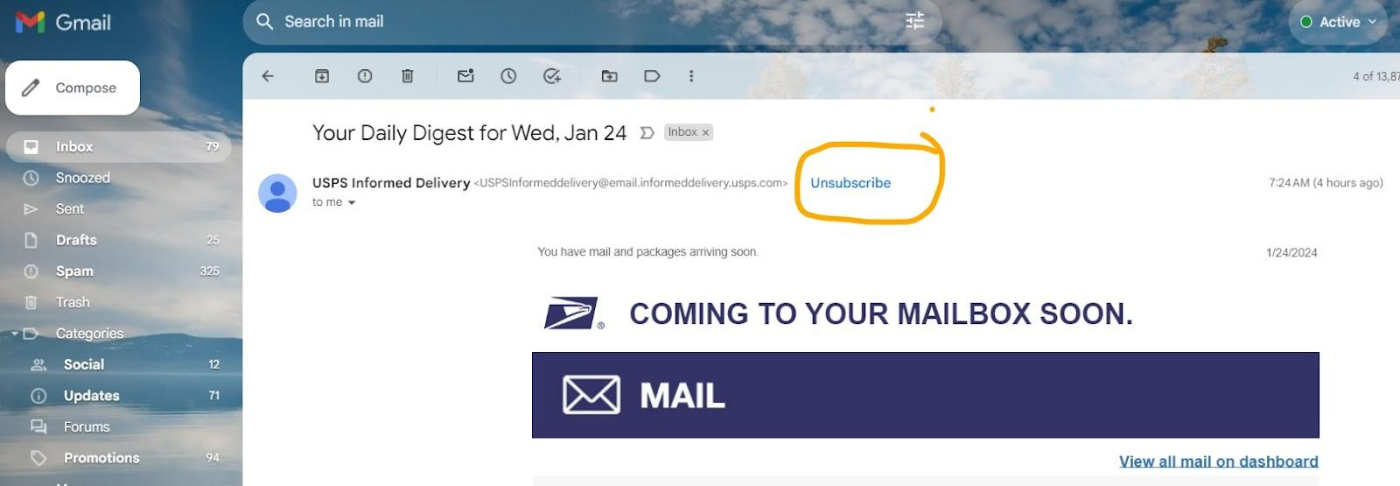
Beginning in February, Gmail and Yahoo! will require any bulk-mail sender to include a list-unsubscribe header (formal document title of RFC8058) in their email campaigns. This feature is completely separate from your normal unsubscribe process and does not pertain to it at all. While unsubscribing from an email list typically involves several steps like clicking on the Unsubscribe link, being redirected to a new page, and confirming desired recipient options, the one-click unsubscribe headers simplify the process a great deal. Having the list-unsubscribe header enabled will allow users to more quickly and efficiently opt-out from any campaigns from the top of their email, ideally using this option instead of marking the email as spam, which will hurt the deliverability more.

YOUR TAKEAWAY

You or your marketing/IT team will need to confirm with your marketing platform(s)/CRM that the list-unsubscribe header is enabled. You might be able to see the unsubscribe option on emails when viewed in Gmail or Yahoo, although that is not always the case. Both providers have a complex algorithm, which takes into account user engagement, sender reputation, and the email content that determines when the option is displayed. In other words, while the option is available and enabled, it might not be visible to recipients. The important thing is that it is enabled to meet the new requirement. 

Additionally, you should confirm that you are suppressing anyone who uses the feature to unsubscribe within two days. This is a crucial step—leaving opted-out records in your communications will not only hurt your domain reputation at that point, but it could also endanger the entire email campaign, resulting in students who wish to see the emails not actually receiving them. 

Example of what the list-unsubscribe header looks like in Gmail:
SPAM RATE LIMIT

Arguably the biggest change, beginning in February 2024 Gmail and Yahoo! announced that they will now enforce a spam rate limit of 0.3%. That’s three emails reported as spam per 1,000 sent. Gmail and Yahoo! define a “good sender” as having less than 0.1% spam rate, which is less than one in 1,000 recipients marking the email as spam. They will issue warnings and begin monitoring the communication if it hits a 0.1% spam rate, but take action if the sender consistently stays at a 0.3% spam rate. At that point, Gmail and Yahoo! will stop delivering the mail, and you might see a drop in domain reputation as well. If the spam rate is left unmonitored, this change will likely result in more of your email campaigns being marked as spam, disrupting their deliverability to user’s inboxes. 

YOUR TAKEAWAY

This cannot be understated, you will need to closely monitor your communication flows to ensure that reported spam rates do not exceed 0.3%. Anything at 0.1% or above should be reworked, and any opt-outs or contact records who have marked the email as spam should be removed from all communications moving forward. As you finalize your email content, make sure to run the copy, subject line, and preview text included, through spam checks and modify as needed until the spam check is telling you the content passes with flying colors. In other words, take no chances.

While the above are changes that will affect marketing efforts in all industries, we are thinking ahead specifically about the impact they will have on higher education and enrollment management in particular. As always, enrollmentFUEL will continue to provide information to you as it becomes available. Our internal data shows that about half of the emails we process for partner campaigns are Gmail accounts, and another quarter are school emails that are often on a Gmail-based platform. Gmail has become a leader in the space, and any changes it introduces are soon after adopted by other email clients, as evidenced by Yahoo!’s participation. Since the changes above are coming on the heels of Apple Mail’s shift in policy in regards to email opens from November of 2022, we anticipate the introduction of more email regulations in the near future as well. 

Changes on this massive scale to one of the most important communications tools at our disposal can be pretty overwhelming. Hopefully, the somewhat intimidating list above has you rallied up and ready to make some positive change. So, we leave you with some final words of wisdom on that front. 

Consider Conducting a Thorough Communication Flow & Email Deliverability Audit

You should go over your communication flow on an annual basis, but we recognize how challenging that could be for a team where many members wear many hats. This is why starting with an outside audit that can pinpoint areas for immediate improvement is a good way to gain valuable insight on how to take action until you have the chance to put routine audits in place. 

Partner Up

Find a knowledgeable partner who understands the changes and can advise you and your teams through rebuilding your communication flow accordingly. 

Pay Attention to Copy

Continue placing significant emphasis on copywriting in order to provide not only content that is unique to your institution, but also running all copy through best-in-industry spam testing services and focusing on the three elements where we can make the most difference to open rates: sender, subject line, and preview text. 

Use Other Channels

Expand on digital and print channels, favoring them over email campaign elements for any list-based campaigns. Additionally, exploring stealth visitor tracking campaigns that target students who have already shown interest by visiting your website should be on your radar. Employ an omnichannel approach and stray away from over-dependence on email to ensure that your message reaches its intended audiences. 

Whatever action steps you choose to take, it is imperative for higher education institutions to adapt and stay ahead of the curve as the landscape of email marketing continues to undergo significant shifts. The impact of the above changes on communication flows, spam regulations, and sender reputation necessitates a proactive approach. Making sure you have taken steps to monitor bounce back activities, implement the necessary DNS records, and embrace the list-unsubscribe header are vital steps to safeguard your email campaigns. Additionally, the enforcement of a spam rate limit strengthens the need for meticulous scrutiny and adjustments to maintain a positive domain reputation. 

In the face of these challenges, don’t forget to conduct regular audits, seek expert guidance on further changes and actions, and diversify communication channels as well. Focus on key strategies for success, such as emphasizing unique content, rigorous spam testing, and exploring alternative channels. Taking proactive actions will ensure that your institution’s message not only reaches its intended audiences but resonates with them as well in the ever-evolving email landscape.
5 Reasons All Colleges Should be Active on TikTok

Higher Ed Digital Marketing | enrollmentFUEL | image of the TikTok app icon on a mobile device screen

5 Reasons All Colleges Should be Active on TikTok

You may know TikTok as the all-in-one platform where users can find videos related to anything and everything. With over one billion monthly active users, TikTok was the most downloaded app of 20221. At enrollmentFUEL, we think TikTok shows promise in helping schools improve yield. Building community is critical to improving yield and we are excited about how TikTok makes students feel like they are a part of your campus community before and after visiting your campus.

Here are five reasons ALL colleges should be using TikTok to enhance their enrollment efforts:

On this platform, organic content is the way to go. Most TikTok users quickly identify and scroll past paid advertising posts, yielding little to no results for the companies pouring money into these ads. 

The secret is that TikTok offers a unique opportunity for organic posts: you can easily go viral and reach a substantial audience without needing to spend a dollar. 

With the right content, hashtags, and strategy and regardless of follower count or previous successful posts, anyone can go viral. 

Gen Z is responsible for 60% of TikTok’s users, and 947,778 users 18+ join the app daily—the exact age demographic that universities target for enrollment! 

Unlike Meta Business, which has prohibited targeting of users under 18 years old (AKA incoming college freshmen!), TikTok is one of the best platforms for targeting this audience. 

TikTok has trends (videos that are followed by the majority of users and gain traction VERY quickly) that immediately resonate with Gen Z and are instantly recognizable to them, making this platform, out of all platforms, the one that is definitely speaking this generation’s language.

TikTok’s main feed is called the For You Page (FYP), a personalized feed with curated content for each user. This page recommends content based on what users interact with. The FYP is the app’s home screen and the first thing people see when they log in, so successfully getting your videos on this page provides a unique opportunity for schools to reach millions of users (primarily Gen Z) quickly

On any other platform, reaching millions of users is only possible if you’re willing to spend hundreds or thousands of dollars. 

What is something that all incoming college freshmen consistently seek? To feel like they’re a part of a community, club, or group. 

Well, guess what? 70% of TikTok users say that they feel like they’re part of a community and 7 out of 10 users feel TikTok communities can affect real change in culture. 

Not only that, but the average scroll time per user is 19.6 hours per month. This means you have 19.6 hours of opportunities to show your university off to prospective students. 

TikTok is the perfect platform for really showing users what your university is all about—the ideal place to showcase your core values, financial aid opportunities, general college tips, and more! 

While other platforms (like Instagram and Facebook) encourage a mixture of casual and serious content, TikTok is praised for its fun, catchy, and, most important, authentic videos. There are thousands of unique ways to illustrate your college’s message and brand on this app without the pressure of trying to make everything fit into a specific standard. 

These five reasons only scratch the surface of what TikTok is capable of doing for your college or university. It is a fast-growing app that every single university, regardless of what their goal is, should use to expand their reach and brand awareness.

5 Reports You Should Have in Your Slate Instance

Slate Platinum Preferred Partner | Higher Ed CRM Services | enrollmentFUEL

5 Reports You Should Have in Your Slate Instance

Enrollment Management leaders need data to share with campus partners, set goals, and motivate staff. Determining which reports your campus should consider can be overwhelming. We’ve created a list of reports that can and should be built in Slate to help your campus thrive.

Build this report on the person base to show current prospects, inquiries, applicants, admits, and deposits. This report gives you a quick snapshot of your current numbers to see how your class is coming together. 

This report should also include data on specific populations you are trying to recruit. If you have goals related to student athletes, diversifying your applicant pool, or increasing your academic profile, include sections showing how those areas perform for the current class. The vice president and admission director can use this report. There may be times when you share the funnel and class profile report with others on campus, but create it with enrollment management leaders in mind.

A three-year comparative report can help campus leaders compare the current status with the last two recruitment cycles. Build this report on the application base to show applicants, admits, and net deposits. 

With a bit of simple math, you can add a formula to display the percent gain/loss compared to the last two years. You will likely share this report with campus partners like the cabinet and sometimes Board members, so I recommend breaking it down by first-year and transfer students and academic areas.

At most institutions, admission counselors’ primary objective is building relationships with their prospective student pool. No matter how your admission counselors log their interactions in Slate, you can create a report to display counts by week or month. This report can help you set goals and gauge your team’s progress.

Use a territory report to help staff members identify trends in their individual territories. Territory reports can include the top ten high schools, majors, hometowns, academic profiles, and other data that will help your team. 

One report can work for all recruiters when you filter on the current user = staff assigned. Like the class profile report, a territory report can display demographic information related to enrollment goals.

Event reports will help you measure the success of your events by displaying the number of visitors by month, comparative number by type of visit, and yield rate on visits. 

Remember, there are two ways to look at campus visits. You can show the number of prospective attendees or the total number of campus visitors. What’s the difference? When you show the number of prospective attendees, each student is counted only once, even if they have visited multiple times. Each visit will count if you show the total number of campus visitors. Both types of reports are useful, so you may want to consider multiple event reports.

This is just a brief list of reports that can help your enrollment management team. If you would like a hand building any of these reports, please contact us!

Maximizing Admissions Yield: Strategies for Boosting College Enrollment

image of college students walking together on campus | Higher Ed Marketing & Student Search Services | enrollmentFUEL

Maximizing Admissions Yield: Strategies for Boosting College Enrollment

Discover effective strategies to boost college enrollment and maximize admissions yield.

Admissions yield refers to the percentage of admitted students who choose to enroll in a particular college or university. It is a crucial metric for institutions as it directly impacts their overall enrollment numbers and financial stability. Understanding the importance of admissions yield is essential for colleges to develop effective strategies to boost enrollment.

A high admissions yield indicates that the college is successful in attracting and convincing admitted students to choose their institution over others. On the other hand, a low admissions yield can be a cause for concern as it may indicate that the college is failing to meet the expectations or preferences of admitted students.

By understanding the importance of admissions yield, colleges can focus on implementing strategies to improve their yield rates and ensure a strong and vibrant student community.

One of the key strategies to boost admissions yield is by enhancing marketing and branding efforts. Effective marketing and branding can help create awareness and generate interest among prospective students, increasing the likelihood of them choosing the college.

Colleges can invest in targeted advertising campaigns that highlight the unique aspects and strengths of their institution. This can include showcasing successful alumni, state-of-the-art facilities, innovative academic programs, and vibrant campus life. By effectively communicating the value proposition of the college, prospective students are more likely to be attracted and consider enrolling.

Additionally, colleges can also leverage digital platforms and social media to reach a wider audience and engage with prospective students. Creating compelling content, such as videos, blog posts, and testimonials, can help showcase the college’s culture and community, further enhancing its appeal.

By continuously enhancing marketing and branding efforts, colleges can increase their visibility and attract more prospective students, ultimately boosting admissions yield.

The admissions process plays a significant role in influencing a student’s decision to enroll in a college. By optimizing the admissions process, colleges can streamline the experience for prospective students, making it easier and more efficient for them to complete their applications and accept offers of admission.

One way to optimize the admissions process is by simplifying the application requirements and providing clear instructions. This can reduce confusion and ensure that prospective students have a smooth application experience. Colleges can also consider implementing an online application portal that allows applicants to track their progress and submit required documents electronically.

Another aspect of optimizing the admissions process is providing timely and personalized communication to admitted students. This includes sending regular updates, reminders, and important deadlines. By keeping admitted students informed and engaged, colleges can increase the likelihood of them accepting their offers of admission.

By continuously evaluating and improving the admissions process, colleges can create a positive and efficient experience for prospective students, ultimately boosting admissions yield.

Targeted recruitment strategies involve identifying and reaching out to specific groups of prospective students who are more likely to enroll in the college. This can include targeting students from certain geographic regions, underrepresented minority groups, or specific academic programs.

Colleges can collaborate with high schools, community organizations, and college access programs to establish relationships and actively recruit students from these target groups. This can involve hosting information sessions, participating in college fairs, and providing personalized guidance and support throughout the application process.

Additionally, colleges can also consider offering targeted scholarships or financial aid packages to attract students who may have financial constraints. By addressing specific barriers to enrollment, colleges can increase the likelihood of students choosing their institution.

By implementing targeted recruitment strategies, colleges can effectively reach and engage with prospective students who are more likely to enroll, ultimately boosting admissions yield.

Building strong relationships with admitted students is crucial to increasing admissions yield. By fostering a sense of belonging and connection, colleges can make admitted students feel valued and supported, increasing their likelihood of enrolling.

Colleges can organize admitted student events, such as campus tours, overnight stays, and orientation programs. These events provide an opportunity for admitted students to experience campus life firsthand, interact with current students, and envision themselves as part of the college community.

Additionally, colleges can assign dedicated admissions counselors or student ambassadors to admitted students. These individuals can provide personalized guidance, answer questions, and address concerns, helping admitted students navigate the transition to college.

Regular communication through personalized emails, phone calls, and social media can also help colleges maintain contact with admitted students and keep them engaged throughout the enrollment process. By building strong relationships, colleges can create a supportive environment that encourages admitted students to choose their institution.

By implementing strategies to build strong relationships with admitted students, colleges can increase admissions yield and cultivate a thriving and engaged student community.

Admissions & Financial Aid Collaboration for Yield Season

Higher Ed Marketing & Student Search Services | enrollmentFUEL | image of professionals collaborating around a table and computer

Admissions & Financial Aid Collaboration for Yield Season

While most training is done in the fall, it is never too late for a quick refresher on important information.

  • Meet with the admission and financial aid staff to make sure they all understand any changes to the financial aid award letters. Show examples and encourage questions so everyone can learn from their peers.
  • Admission staff are often trained on value and marketing messages. Be sure your financial aid officers are also able to speak to those points when counseling students.
  • Have you spoken to the Business Office, coaches, and other campus stakeholders about changes to awarding and financial aid packaging documents? Make sure you are all on the same page when students call with questions. Don’t forget your IT department if emails are also being assigned at the time of acceptance or deposit.

Hold a weekly progress meeting, because having a designated time to talk encourages collaboration to meet your goals. This may also be a good time to talk via phone with your leveraging consultant (if you have one) and discuss any reports they are providing.

Topics for the meeting should include:

  • Who has submitted a FAFSA but not yet replied?
  • Who has applied, but not filed a FAFSA?
  • Where are you running ahead or behind compared to your model?
  • What steps should be taken by team members to adjust to the results you are seeing?
  • What are you hearing about competitors’ awards?
  • Are there strategic goals you should be tracking closely and reporting to your President and Board?

Is the staff at your school calling students to discuss their financial aid award letter and ranking students based on their reaction to their award letters?

Discuss the feedback you are getting from students and families, and then review your communications. Are you addressing concerns heard by your team as the awards go out? Should you send text or voice reminders for families to complete documents or let them know the letter is on the way or in their inbox?

If Admissions and Financial Aid are not using the same CRM, are both teams able to see notes made by the other on a prospective student and conversations that have occurred?

At the end of the cycle, it’s wise to review the process. Take a day to sit down once the class is in and analyze what worked and what didn’t. By reviewing your financial aid strategy, you can adjust and be ready to meet the next enrollment goal.

The New Year is the Middle of the Cycle

Higher Ed Marketing & Student Search Services | enrollmentFUEL | image of female college students walking across campus together

The New Year is the Middle of the Cycle

The holidays can arguably be considered one of the best times of year! But they also represent a point that is the middle-of-the-road in admissions.

The days leading up to the break are usually jam-packed and chaotic. There are application reviews, senior-level meetings, in-house processing mishaps and the day-to-day office grind. Although there was plenty to do, some of the staff probably shifted into break mode before it even began.

Vacation flew by, and now you’re back in the office. If your team seems a little sluggish, here are two ideas to shake-off post-holiday slow-downs.

If you aren’t already doing this, press pause on the frantic pace and conduct a mid-year retreat. Take a day (or a half-day) to create a snapshot of the recruitment season. No, this isn’t another “to-do” mark on your checklist. It’s really a group project. Each counselor would be responsible for providing a brief review of his/her territory. This gives each teammate a sense of ownership. It’s also a great way for first-year counselors to hear from others, share ways to improve travel, and, more importantly, begin the process of learning how to decipher data. Those extended morning chats can now become data driven!

Use this time to have an open discussion. You can address hard conversations head-on. What has worked? What needs revision? What needs reconsideration? These concerns often relate to office programming and structure. It will allow you to facilitate dialogue, encourage solutions and stop the complaining. Teams are enhanced when people are heard while feeling empowered to provide suggestions. The responsibility falls on everyone.

This event also serves as an opportunity to recognize staff members’ accomplishments (such as presentations selected for conferences, graduations, engagements, marriages, etc.).

This event also serves as an opportunity to recognize staff members’ accomplishments (such as presentations selected for conferences, graduations, engagements, marriages, etc.).

  • Write three goals for the first month upon returning.
  • Write two goals for the semester.
  • Write one goal for the calendar year.

The goals are usually programmatically or territory-related. The “goal of the year” can be a personal one, such as getting into grad school, presenting at a conference, or successfully leading a campus program for the first time. This big goal often focuses on professional development.

As the year progresses, bring up the 3-2-1 Punch! during staff meetings to keep people focused on progress and celebrate wins. Recruiting life influences our inner-competitor, and people like winning. When they’re winning because they’re challenging themselves and the team is rooting them on, it creates a situation where everyone benefits.

The holiday break gave you time to recap, rethink and recharge. Now, 2018 is here, and you’re ready to go. Here’s to a great year ahead, and success in achieving your goals.

Top 5 Action Items for Successful Cycle Planning

Higher Ed Marketing & Student Search Services | enrollmentFUEL | image of mechanic working under the hood of a vehicle

Top 5 Action Items for Successful Cycle Planning

Enrollment planning is a little like automobile maintenance. Sometimes all you need to do is tune up the process. Sometimes things are broken, and you need an overhaul and new parts.

The trick is being able to distinguish when to do what, so you get the results you want.

Here are my top 5 actions items for effective planning for a successful cycle.

Analysis sheds light on problems and opportunities. Seek insight from both qualitative and quantitative data to answer take a deep dive into who your recruits were and how they acted.

  • Where did your enrolled students come from?
  • Did they act as you expected and had planned for?
  • Were there any market shifts?
  • Were there any notable changes in the incoming student profile – academic quality, diversity, financial need, legacy, denominational ties, co-curricular and academic interests?

During this stage, you are opening a Pandora’s box. Let your experience guide you on the most important problems to solve, because you can’t always fix everything.

Visits take more time, require a greater investment, and involve more people than anything else in the recruitment process. There is also a huge pay-off for campus visits, so paying close attention to this is one of the most important things that admissions leaders can do.

A few years ago, I realized that the campus visit experience didn’t start when the visitors arrived in the guest parking spot. It started when the prospect (or the prospect’s mom) began setting up the visit – the call to the admissions office, the web form to set up the details of the visit or an email exchange with my admissions staff.

Investigate to eliminate friction. Was the process to schedule easy or awkward? Was it intuitive and fast? Was my team responsive? Did we ask the right questions? Were we welcoming? Was the visit memorable? Did we follow through with our brand promise? Did we allow changes to be made? Could the visitors tell the difference between my college and others being considered? And finally, is the campus tour telling our story or giving lots of factoids? There’s a huge difference!

The days are gone that having a CRM is optional. Your CRM is an essential communication tool. When this tool does not perform, you could be operating with a competitive disadvantage.

  • A CRM performance assessment helps you understand if it is working for you – or if you are working for it!
  • Is the CRM being used by your recruiting partners across campus?
  • Does it play nice with your SIS (data migration)?
  • Is it helping you communicate effectively with my prospects?
  • Does it track your students so you can identify the deeply interested prospects from the “just looking”?
  • Can you get accurate information when you need it?
  • Do you have access to the right data dashboards?
  • Is the data easy to interpret?

The answer to the last question is critical to success. There is nothing worse than having an abundance of data that no one can understand. Information is only useful if people know what it means.

An effective communication plan begins early in the life of the prospect and builds over the course of time. Every recruitment cycle, it pays to review letters, emails, texts, postcards and brochures. Pay close attention at message progression, message intentionality, and institutional brand voice.

Parents are important, so have a solid communication plan for them, as well as students. You will need to inform, woo, celebrate and convince them that your institution has value for their students. Along with often paying the bills, parents can also be gatekeepers and agenda-setters in the college search process.

There is nothing more exciting – and effective –when recruiting a class as when the entire institution communicates the same brand message to prospects. Whether it’s a tour guide, a professor, a coach or an admissions counselor, when everyone says the same thing, students and parents are more likely to hear, understand and retain messages about your institution’s value.

I call it “ringing the bell.” When an institution knows who they are, what makes them different from others, and can communicate that clearly, there is purity of sound in communications. It is essential enrollment leaders do whatever they can to bring that harmony to the messages throughout the recruitment cycle. Often, this means training your colleagues in other departments on new programs, athletic teams, facilities, delivery models, outcomes and so forth, because it is a vital step in ensuring authenticity and transparency – two attributes sought by today’s students and their families.

Two decades of enrollment management experience has taught me that planning is not a perfect science, but there is tremendous value in taking a structured approach to the planning process. Before you start another cycle, there is value in understanding what worked and where there are opportunities for improvement.

Academic Credit or Potential to Persist?

Higher Ed Marketing & Student Search Services | enrollmentFUEL | image of college students walking together across campus

Academic Credit or Potential to Persist?

A 2006 National Center for Educational Accountability1 study showed that Advanced Placement (AP) students are more likely to have higher grade point averages and to graduate on time, than their counterparts who don’t take AP classes. This holds true across races, gender, and social-economic statuses.

Given this data and your enrollment goals, consider this: are you recruiting to enroll as many students as possible with college credit? Or, are you seeking to enroll as many students as possible that can handle the academic rigor of college?

It’s a good question to consider because even when students don’t present an AP score that is eligible for college credit, they generally perform at a higher level. Since they have been exposed to rigorous work, their transition to college is often easier than their peers who have not had any exposure to advanced courses.

Using a multi-year strategy built around the goal of communicating with qualified students, how can you access talented students before they have PSAT, SAT or ACT scores?  Consider the following:

  • More than 1.17 million students from the class of 2017 took AP exams  [2]
  • More than thirty-eight different exams are offered in seven subject categories [3]
  • AP exams are most often available to 11th and 12th graders, and occasionally to 10th graders [4]
  • Students who perform well on AP STEM exams tend to graduate with a STEM degree more often than those who did not take the exam [5]
  • High school AP students have a higher college graduation rate than non-AP students [6]
  • According to a recent USA Today, females, minority, first-generation and rural students saw dramatic increases in AP Computer Science exams [7]
  • Since 2007, AP has consistently grown in the majority of participating states [8]

While there are states that have disproportionate numbers of SAT or ACT students, almost all states include Advanced Placement as options for courses – which serves as an indicator of access to rigorous preparation. Students frequently take an AP course before they take any college entrance assessments. In 2017, more than 2.7 million students took more than 4.9 million AP exams [9].  While not all will opt-in to Student Search marketing, those that do present a sizeable pool of students who have been exposed to rigorous coursework.

To find more students who will persist (and ultimately graduate) consider searching for AP students with non-credit eligible scores.  These students are not typically recruited, but here’s why they should be:

  • Academically talented first-generation, minority and/or rural students
  • Students interested in STEM fields
  • Women and underrepresented minorities in Computer Science
  • Students with interest in languages
  • Even if they don’t major in the discipline, AP students take more upper-level courses in their chosen field

AP students typically have demonstrated a deeper interest in a content area.  Communication outreach should recognize the different qualities these students bring and be tailored, accordingly.  Think of creative methods to involve the rest of the campus to help recruit these students—they could be the subset that pushes you and your team over the goal.

[1] Dougherty, C., Mellor, L., & Jian, S. (2006). The Relationship between Advanced Placement and College Graduation. National Center for Educational Accountability. Retrieved from https://files.eric.ed.gov/fulltext/ED519365.pdf

[2] AP Program Results: Class of 2017 (Rep.). (2018). New York City, NY: CollegeBoard. Retrieved from https://reports.collegeboard.org/ap-program-results/class-2017-data

[3] AP Courses. (n.d.). Retrieved from https://apstudent.collegeboard.org/apcours

[4] Policy: Appropriate grade levels for AP courses. (n.d.).  Retrieved from https://secure-media.collegeboard.org/apc/Appropriate-Grade-Levels-for-AP-Courses.pdf

[5] Smith, K., Jagesic, S., Wyatt, J., & Ewing, M. (2018). AP STEM Participation and Postsecondary STEM Outcomes Focus on Underrepresented Minority, First-Generation, and Female Students.  Retrieved from https://files.eric.ed.gov/fulltext/ED581514.pdf (ERIC Document Reproduction Service)

[6] Dougherty, C., Mellor, L., & Jian, S. (2006). The Relationship between Advanced Placement and College Graduation. National Center for Educational Accountability. Retrieved from https://files.eric.ed.gov/fulltext/ED519365.pdf

[7] Suppe, R. (2018, August 27). Female, minority students took AP computer science in record numbers. Retrieved from https://www.usatoday.com/story/tech/news/2018/08/27/female-minority-students-took-ap-computer-science-record-numbers/1079699002/

[8]  AP Program Results: Class of 2017 (Rep.). (2018). New York City, NY: CollegeBoard. Retrieved from https://reports.collegeboard.org/ap-program-results/class-2017-data

[9] Annual AP Program Participation 1956-2017(p. 2, Rep.). (2018). New York City, NY: College Board. Retrieved from https://secure-media.collegeboard.org/digitalServices/pdf/research/2017/2017-Annual-Participation.pdf[/vc_column_text][/vc_column][/vc_row]

Enrollment Consideration Sets: Strategies to Score

Higher Ed Marketing & Student Search Services | enrollmentFUEL | group of college students communing on campus

Enrollment Consideration Sets: Strategies to Score

As the recruitment cycle resets, enrollment management professionals will continue to strategize on how to create the class for the upcoming year.

Counselors will attempt to determine which prospective families are considering their school as part of three “consideration sets.” In general, a consideration set is just what it sounds like: a set of schools a student contemplates before making a final decision. It goes beyond brand awareness. The list has been narrowed down, based upon criteria established by its key stakeholders: the student and parent(s). I would like to discuss three distinct consideration sets where a student must engage.

These are defined as consideration to:

  1. Apply
  2. Deposit
  3. Enroll

Each choice point requires different motivations. With strategic planning, an institution’s goal is to insert itself into each stage of consideration and to facilitate enrollment.

Here are a few things to keep in mind when tackling consideration sets in the recruitment process:

At this point, the family has narrowed down a list of recognizable schools, based upon key factors associated within their specific criteria. Understanding student demographics, institutions with similar offerings (i.e., cross-applications), and application completion rates are the key to pushing students through this stage.

As a search initiative, it is imperative to ensure we meet students “where they are,” in terms of applying. What are barriers slowing down the application process? How can you make the process as easy as possible? What prevents students from completing and submitting their application?

At this stage, it is a great time to think about retargeting search initiatives, based on where students may be “ghosting” the process. You could also focus on a specific group of students to expand, so you can understand how/why they “abandon their cart” at this stage.

The student has been admitted. The time has come to commit. What yield efforts have been established to get them over the hump?

During this crucial time, it is important to recognize parents are also heavily invested in the decision. Communication plans for both parties should exist to keep each demographic informed. How does your plan differ from other institutions? What engagement initiatives are in place? Motivating students and parents to submit the deposit depend on customer service, transparency about financial options, and outcomes, as well as other factors. Tap into the personality of the institution, and the power of personalized interactions.

They deposited! You won, but now, you must get them to the school. “Summer melt” is the bane of enrollment professionals. You must have a proactive plan to get in front of this problem and win this final consideration set. Everyone wants to be proactive during this stage. However, it becomes tricky, since each deposit carries a unique story. Consider all the possibilities and develop an action plan that evaluates data (quantitative factors) as well as anecdotal factors.

The summer before college is an exciting time. Students are usually more active on social media. What plan has been established to maintain a presence, while promoting online authenticity? What about parents? Has direct mail been abandoned by the time you reach this stage? Why or why not?

Great ideas come from counselors who have “closed the deal” and walked students/parents through this stage. They have first-hand knowledge of last-minute objections and concerns and can offer detailed insight for messaging and tactics.

To win the consideration game, it is important to keep the immediate goal in mind within your comm flow. To win, you also must use CRM data to understand where the inquiry is in your funnel. Linking messaging and communication tactics directly to the contextual decision-making help to achieve the ultimate goal of increasing yield.

One effective tactic for sending the right message at the right time is an IP targeting campaign. Using this form of digital advertising allows you to serve up messaging that is directly tied to the next step you want the student to take. When students click, a successful campaign takes these “hand raisers” to a page on the web that is built to resell your institutions’ value, while motivating students to take action now. When you combine IP targeting with other tactics like email marketing, direct mail, and personal touches from counselors, it can give you the edge you need to gain a spot in a future student’s consideration set.

As you can imagine, there is no one-size-fits-all methodology to win. Every student, parent, and institution is different. Enrollment marketing is an ongoing and flexible process. Enrollment professionals must also understand the type of student the institution is attracting, and know how to develop relationships. To win the consideration game, you must do all this and then evaluate data to determine where opportunities for improvement exist and act upon them.

The Marathon is On! Recruiting Tips for the Upcoming Cycle

Higher Ed Marketing & Student Search Services | enrollmentFUEL | image of college students walking across campus together

The Marathon is On! Recruiting Tips for the Upcoming Cycle

Whether you are up or down in your applications, admits, and deposits, we all know there’s still a long way to run in the recruiting marathon. So here are a few ideas from our team to keep you on track to meet your goals.

When FAFSA opens up, look to see who in your inquiry pool has already filed a FAFSA and not applied.  I used to run this report once a week, and my admission team would follow-up with all inquiries who had not applied, treating them as a HOT lead.

If you start awarding early, it’s also not too early to determine where those students may be falling on your matrix to determine where you might be up or down when it comes to meeting net tuition revenue goals.  If you have begun to award, then check to see if your team is following up with students who have received packages to talk through the package. Work to uncover potential gaps that will prevent the student from enrolling later on.

Now is also a good time to keep your ear to the ground. What are you hearing about your competitors’ awards and packages? Use any information you uncover to prepare and train your team to talk through various scenarios with families.

While it’s great to get a head start on the students who come in early with financial aid, we also know that you have an entire inquiry pool of students who are still considering applying. Make sure you are continuing to work your inquiry pool, along with any new inquiries that come in during this time. Fresh off the road from travel, counselors should be calling to reach out, follow-up, and build relationships.

Communications during this time should also continue to encourage visits and applying for admission.  If you already have a robust communication flow, consider adding in some messages about their academic areas of interest. Consider having your faculty reach out to ten students from feeder high schools or to 10 students modeled to be highly likely to enroll. It’s a personalized touch that can make a difference.

Many institutions also run application campaigns during this time.  Application campaigns should include banner ads, direct mail, email, and calling as appropriate. Even if you have a partner running an application campaign for you, you need to focus internal effort on this and not rely solely on the outside partner to achieve your goal.

It’s also a good idea to push applying through social media. Your marketing office can align both planned and grassroots efforts to push students to apply. Align your big apply pushes with social and amplify the message by asking parents of current students or alumni in key areas to share these messages, expanding the audience reach.

Once students are admitted, it’s a great time to bring in faculty, coaches, and even current students to help the admission team build relationships and transition those marketing messages into real-life experiences.  Communications to this group should include specific messages about their major of interest and activities they may want to pursue. Depending on the size of your institution, you can engage students in calls, emails, and letters from faculty, and it’s also a great time to send a note from your Chief Academic Officer.

Starting now, look for ways to make admits feel like they are already part of campus. Invite them to hear a speaker on campus. Plan admitted student events for spring on campus and in their local area.

Don’t overlook the power of student perks! During the winter season, I offered deposited students a chance to get their university athletic ID card, allowing the next class to get into games for free or at a reduced cost and buy spirit-wear at a discount. It has their name on it, an ID barcode, and the school logo. It’s one small step to helping the students feel like they are already part of the community.

Communicating directly to parents is huge this time of year at all funnel levels. Having a solid communication plan to let parents know that the university thinks their student is great helps to win the family over.

Plan for a Mid-Year Pressure Valve

Next fall will have less pressure if you bring in a few more mid-year students. Using all of the above tactics mid-year can prove very fruitful!